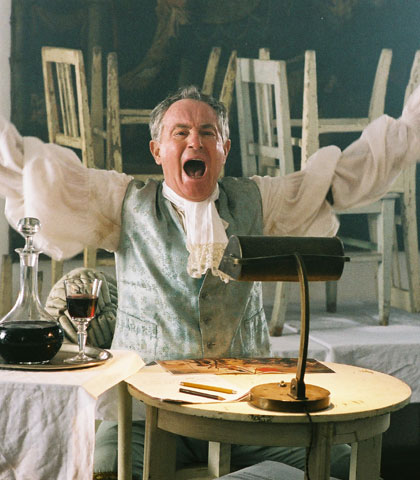
This may be the creepiest movie you've never seen. Made by Hammer Film Productions, it isn't one of their gothic romps. Those pictures are a lot of fun and you can enjoy yourself immensely either pretending to be scared or just wallowing in their nostalgic glow, but this one is a different manner of ick entirely.
Based on a play by Roger Garis called The Pony Cart, and with a screenplay by John Hunter and direction from Cyril Frankel, Never Take Candy From a Stranger (aka Never Takes Sweets From a Stranger), the film is the story of Peter and Sally Carter, with their pre-adolescent daughter Jean (Patrick Allen, Gwen Watford, Janina Faye) who have moved to Canada so Peter can take up the post of headmaster at the local high school.
One night, Jean tells her parents that she and her friend Lucille (Frances Green) had visited the Olderberry mansion because Lucille knew there was an elderly man there who would give them candy. Clarence Olderberry, Sr. (Felix Aylmer) promised to give the girls sweets if they would remove all their clothing and dance for him. The girls do (all this is offscreen) but now Jean is worried because she knows they shouldn't have done it.
When the Carters complain to the police they are told that the Overberry family owns the town and it's best to just forget about the old man's little problem and warn Jean never to visit him again. The Carters want more, for the sake of all the town's children, and force the police to bring Overberry to trial, where the defense counsel (Niall MacGinnis) twists everything Jean says on the stand and makes her look unreliable, at best.
Overberry is acquitted, as the Carters were warned he would be, and before they can move out of town Jean and Lucille go walking in the woods, and guess who they meet? His pursuit of the girls through the woods is chilling, mainly because Alymer, as Overberry, never speaks a word throughout the film. His aging pervert is not so much evil as he is stuck mentally in an evil place. He could easily be in the throes of early dementia. He shakes, he dribbles, he smiles vacantly, and when he sees little girls, he desires one thing only.
If the film were merely the story of a sexual predator on the prowl for children ("merely"?) it could easily be dismissed as exploitation of the worst kind—what a lot of viewers would expect from Hammer. But it's a true horror movie, the horror enhanced by the town's willingness to take chances with the lives of children if it can keep the factory open and the citizens working. This is a plot device that has become familiar in scary movies—think of the mayor insisting on the beaches staying open in Jaws—but, somehow, adults getting eaten by a fish is less upsetting, and a lot more playfully entertaining, than an elderly child abuser terrorizing young girls.
Thursday, September 30, 2010
Never Take Candy From a Stranger (1960)
Monday, September 13, 2010
Lunacy (2005)
If you're looking for a pleasant night out to help your mom celebrate her birthday, unless she's Irma Grese, the Bitch of Belsen, you better look elsewhere.
On the surface, Jan Svankmajer's surrealist black comedy is about a man who may or may not be insane and his adventures with a Marquis who may or may not be insane as they tour a madhouse run by a staff that may or may not be insane. Odds are that they're all lunatics, but that's just my opinion and, according to this movie's underlying point of view, I may or may not be insane, too.
We tend these days to use some variation of the word "surreal" in place of "it was weird and I don't have a clue what it meant." You know, like an off-the-cuff joke from George W. Bush.
But sometimes "surreal" still refers to an avant-garde art movement, and that is the surreal that describes writer/director Jan Svankmajer's 2005 film Sileni—Lunacy, to you non-Czech speakers.
The film opens with a brief prologue in which Svankmajer addresses us directly, telling us that we are about to see a horror movie, with all of that genre's attendant degeneracy. He warns us that he has borrowed motifs from Poe—he calls his movie an "infantile" tribute to the American gothicist—and adopted the blasphemy and subversion from the Marquis de Sade.
We join the film as a young man named Jean is having a nightmare in which two bald and burly sanitarium attendants are smilingly attempting to put him into a strait-jacket. This dream incorporates some stop motion animation of a shirt crawling across the floor. Many of the film's most intense moments are interrupted by this animation, usually consisting of tongues and eyeballs cavorting on their own to the accompaniment of carousel music.
Jean soon meets the Marquis, an 18th. Century man in the 21st. Century world. Jean is invited to stay a few nights at the Marquis' castle. He accepts, but when he spies the older man conducting a blasphemous parody of the Mass one night, complete with naked altar servers, he decides to take the innocent village maid the Marquis seems determined to corrupt and run away with her.
Instead, he is talked into accompanying the ignobleman on a tour of the local insane asylum where he finds out that the innocent maid is in fact the head nurse. She tells him that the chief doctor and the Marquis are actually inmates who led a mutiny. Now the real hospital staff is locked in the underground dungeon and the loonies are in charge.
By the time the story ends, if it does, telling who's insane and who's lying is impossible so we settle for believing that, as in Alice in Wonderland—a story Svankmajer filmed in 1988—we're all mad here.
It's clear that Svankmajer sees the madhouse as a suitable symbol for modern life. One of the doctors believes in severe corporal punishment and one believes in letting the patients do whatever they want to do. Conservatism and Liberalism, anyone? But since nothing works, who cares?
There is much black humor at work here, and despite the claim that it's a horror movie, Lunacy is never scary on a visceral level. If it creeps you out, it'll probably be due to self-recognition. This observation does not apply to me, of course.
White tie is optional. Strait-jackets are required.
Friday, September 10, 2010
In This Our Life (1942)
Few things in nature are more wonderful and terrifying than a Bette Davis character in the throes of pure petulance and malice. That being the case, you can't do better than spend an evening with In This Our Life.
This was John Huston's second directorial assignment and while he doesn't seem as close to this material as he was to the hardboiled milieu of Dashiell Hammett's mean streets in The Maltese Falcon, he's having one helluva good time with Ellen Glasgow's southern gothic lite as scripted by Howard Koch.
The story takes place deep in the heart of The Land of Sociopathic Women. Davis is Stanley Timberlake, one of old Asa Timberlake's (Frank Craven) two daughters. Olivia de Havilland is the other one, Roy. The male names are not explained in the film and I haven't read the source novel. As the film opens, Stanley is about to be wed to a champion-of-the-oppressed local lawyer, Craig Fleming (George Brent). At the last minute, and for no apparent reason, Stanley abandons Craig almost at the altar and runs off with Roy's husband, young Dr. Peter Kingsmill (Dennis Morgan, who acquits himself nicely and may come as a surprise to viewers who know him only from his musical roles).
Stanley and Peter leave town and Peter gets an intern's position at a hospital. His salary is meager and his new wife is quickly and easily bored. Her constant nagging leads Peter to take Drastic Action, and soon Stanley is back home, where by now Roy and Craig have become an item. These southern girls don't let the grits grow under their feet, by cracky.
Of course, Stanley sets out to re-capture Craig and there is some chance that she may be able to do it. She makes an appointment with him to meet at a bar that night at 7:00. While waiting, she tosses back a few and when he hasn't shown up by 7:30, Stanley speeds off in her roadster. We've been told that she drives too fast and now we find out that with a few drinks in her she's capable of hit and run driving. When the cops find out that the car involved was hers, she tries to put the blame on Parry Clay (Ernest Anderson), the son of the Timberlake's black maid Minerva (Hattie McDaniel).
The other major player is the Timberlake girls' grating Uncle William (Charles Coburn). William is their maternal uncle and it's well known that he partnered in his brother-in-law's tobacco company, then forced Asa out. Now he enjoys calling on the Timberlakes in their modest house and rubbing everyone's nose in his dishonorable success. His only fan appears to be Stanley, who flirts with him because he's the rich relative.
Coburn was 65 when he made this picture and Davis was 34, and still the characters play the "I've got a surprise for you in one of my pockets and if you find it you can keep it" game. It's creepy, no doubt about it.
The picture is a hoot, with everyone playing just one notch above where people actually exist—not close enough to reality to turn this into drama but not so far up the wall that the whole thing becomes more camp than a field full of tents. Every time I watch this one, I'm wearing a huge grin on my face.
Friday, June 18, 2010
The Screaming Skull (1958)
Recent DVD and theatrical releases of movies by Dario Argento have started me thinking about that oddball breed of cinema we know as "cult movies," or "guilty pleasures." I'm one of those people who don't usually use the latter term because if I enjoy a movie I don't see any reason I should feel guilty about it. Hell, if I felt the need to apologize every time I enjoyed The Lost Skeleton of Cadavra or a Wheeler and Woolsey comedy, I'd be more weighed down by guilt than Judas Iscariot wearing an SS uniform while clubbing baby seals with a burning cross.
Actually, not all guilty pleasures are cult movies. To be a cult movie, a picture has to be appreciated by a number of people and is generally thought to be "so bad it's good," making cult movies at least a subset of camp. Guilty pleasures—or as I like to call them, "what I watch on Friday nights"—may be totally unrecognized by others and don't have to have any redeeming qualities whatsoever beyond the perhaps perverse pleasure they provide for me personally.
I've thought many times that I'd like to write a series of pieces—part reviews, part criticisms, part appreciations, part apologetics—on these movies from closer to the bottom of the cinematic barrel in hopes of scamming, uh, encouraging you to cultivate your inner movie slob. No, seeing every new Adam Sandler movie on its first weekend of release doesn't count. That's just conformist bad taste and I know you can do better than that.
Let's begin 50 years ago, at childhood, that time in life when a person's tastes—good and bad—are formed. The theater is The State, on the square of the small Texas town in which I grew up. The State played "B" movies and, on Saturday mornings, pictures in Spanish for the farm workers who came into the city for a few hours. But what I loved there best were horror movies like …
The Screaming Skull (1958)
You can tell which schlockfest "B" horror movies manipulate the basic accoutrements of the genre best by the degree to which they scare the bejeezus out of small children, and one of the things that has great power to create a seat-wetting problem is the human skull. You don't even have to give the ridges over the eyes that Harryhausen touch to make them look more sinister, but it can't hurt.
I had just turned nine when I saw The Screaming Skull for the first time, and it scared the breath out of me. Fifty years later I can still remember being so frightened I couldn't yell. Ah, those were great times … Macabre came along later that same year, with House on Haunted Hill and The Tingler (both 1959) soon to follow. We adolescent horror hounds, readers of "Famous Monsters of Filmland" all, were convinced that William Castle was the greatest filmmaker of all time. Even Psycho (1960) couldn't pull us away as it was a little too adult—but we still read everything by Robert Bloch we could get our sweaty little hands on.
I don't know if journeyman actor Alex Nicol, who directed The Screaming Skull in an effort to expand his career possibilities, could have beaten Castle into our hearts had he continued to make shockers. (Can you imagine a grown man still considering such a question? Neither can I.)
I've re-visited TSS several times over the decades. It used to show up on late night TV with some regularity, until even the tube outgrew such hack work, and more than one DVD distributor carries it in the catalogue. No, the original fear is long gone—I wish I knew a nine-year old I could convince to watch it in a dark room just to check out the reaction—but the memory is intact.
In the film, a newly wed couple come to the house the groom lived in with his former wife, the haunting Marion, who died in a sudden thunderstorm when she slipped on a wet leaf and stumbled by the lily pond, cracking her head open on a stone wall and then drowning. I'd think that this plot construct was an accidental reference to Ibsen's Rosmersholm except for the fact that composer Ernest Gold—yes, the same man who would win an Oscar for scoring Exodus in 1960—borrows the same brooding Sabbat theme from Berlioz' Symphonie Fantastique Stanley Kubrick used in The Shining (1980).
Maybe this movie is smarter than it has any right to be. John Kneubuhl, who would later write the "Pigeons From Hell" episode of Boris Karloff's TV program Thriller, wrote the script based on the legend of the screaming skull of Bettiscomb Manor, in England.
But setting references to classier stuff aside, Eric and Jenni Whitlock attempt to settle into the house. As he introduces her to the grounds, Jenni spots a small outbuilding and asks what it is.
"That's where Mickey keeps his gardening things," Eric replies.
"Who's Mickey?"
"The gardener."
Or maybe the movie isn't any smarter than it has to be. But you know that feeling you sometimes get, the feeling that the filmmakers are playing around a little because they know the kids that make up their audience aren't going to get it, anyway? TSS engenders that feeling often.
Soon, Marion's great friends, Reverend and Mrs. Snow, drop by for dinner and via some pretty unsubtle dialogue we learn that a) Mickey is still devoted to Marion and thinks her ghost haunts the house and grounds, b) Jenni had a nervous breakdown and was committed to a sanitarium when her parents were killed in an automobile accident, c) she is wealthy, and d) John Hudson, as Eric, is either the most ham-handed actor of the 1950s or he has been directed to make it clear to even the most naïve members of the audience that he wants to gain control of his new wife's fortune.
Later that night, Jenni awakens to discover that Eric is missing, a window is banging in the wind, and Marion 's self-portrait looks creepy in the moonlight. The next night, this scenario is replayed, only this time Jenni finds a skull in a cabinet. She tosses it out the window, but on her way back to bed she hears a knocking on the door and, yes, it turns out to be the skull.
It's not much of a spoiler to admit that Eric is behind all the, uh, skullduggery, but whether or not there is a real ghost on his trail I will leave to you to discover for yourself. If you've ever read a pulp magazine weird menace story, or watched an episode of "Scooby-Doo," you'll have no trouble figuring out the late night mumbo-jumbo.
Hudson, who was Capt. Hobart in G.I. Blues (1960) and Virgil Earp in Gunfight at the O.K. Corral (1957) was certainly a better actor than this script calls for, and I suspect he was playing the evil genius with deadpan irony. Peggy Webber, as Jenni, looks a bit too robust to make a convincing Mrs. de Winter clone. Like almost every other actor in the film, she found her greatest success on TV. Leading roles in movies were out of the question—bless her, she looks like Nicholas Cage in drag, but with heftier boobs.
Russ Conway, who had unremarkable roles in What Ever Happened to Baby Jane? (1962) and The St. Valentine's Day Massacre (1967) gives Rev. Snow a quiet, patient demeanor even though he looks fit enough to beat the crap out of Eric. Tony Johnson, as his wife, has no other credits on IMDB.
Director Alex Nicol, who plays Mickey, will be better remembered from his small roles in movies, including The Man from Laramie (1955). He later went to Europe to take part in the spaghetti western boom, coming home for a turn as George Barker in Roger Corman's Bloody Mama in 1970.
In TSS he shows a nice camera eye for the clichés of the genre. His camera roams the empty halls of the house, creeping up on certain doors and importing to them a sense of dread that makes us both want to enter and run screaming away. I suspect that the movie would still work its dark magic on young kids, but many of them would be repelled by the questionable acting and black and white photography.
The film exists as a link between gothic chapbooks, dime novels, spooky radio shows, the pulp horror magazines and EC comics, and TV horror shows like Thriller and The Twilight Zone. Moments in it seem to have influenced Freddie Francis' The Skull (1965), which, since it was based on a story by Robert Bloch, takes us back to where we started.
The Screaming Skull can't possibly scare adults, and unless you saw it when you were young it won't have any nostalgia appeal. But honestly, I've known several grown-ups who did see it back in the day, and they all remember it fondly as one of the scariest movies they've ever seen. Maybe we should let it go at that.
Wednesday, October 3, 2007
Jeepers Creepers (United Artists, 2001)
As the movie begins, Trish and Darry (Gina Philips and Justin Long), brother and sister, are driving the back roads on their way home for a visit from college. Trish likes to look at the countryside. They are briefly pursued by an enclosed truck, the unseen driver of which seems determined to scare them spitless. Finally, the truck passes them.
Sometime later, they see the truck parked beside an abandoned wood frame church, surrounded by trees, its yard overgrown. The siblings see the driver of the truck carry a bundle that looks suspiciously like a dead body wrapped in a crimson-stained sheet. “The Creeper” deposits the bundle into a large pipe sticking out of the ground. They slow down and he dumps another one.
The Creeper spots them and the chase begins again. Darry drives off the road into a field, and the truck continues on its way.
The kids go back to the pipe to make sure of what they saw and to convince themselves that if bodies there are, they are all dead.
Darry thinks he hears someone down in the hole, and, of course, is determined to climb down for a closer look.
“You know that place in horror movies where someone does something really stupid and everybody hates him?” Trish asks. “Well, this is it.”
Of course, Darry falls into the hole and, of course, we think The Creeper is coming back at any moment and, of course, the hole is more full of corpses than a cheesecake is full of calories. From this point on, the film becomes a conventional killer chases kids thriller.
It holds up well up to the point Darry and Trish bring the cops into the picture. It’s at this point our understanding of what The Creeper is begins to change. The more we know about him, the less frightening he is.
Do you remember watching monster movies as a kid and feeling less scared when the monster was already on the screen because you knew that if you could see it, it couldn’t jump out and yell “Boo!”
Salva has forgotten that basic point. John Carpenter, in “Halloween,” reminded us that you can’t kill the bogeyman, but you shouldn’t take too much time trying to explain him, either. That kills him more effectively than blades or guns.
As long as The Creeper remains unseen, or seen in shadow, he represents that potent, visceral force of the Unknown. When he hunts, does he do it for fun or is there a solid reason for all the corpses he’s dumped down the pipe? Why all the incisions? Why is the catch phrase for this picture “What’s eating you?”
And what’s the significance of the number “23”? You’ll know what I’m talking about if you ever see the flick. And there’s a legend that ties into the plot. Is it a real legend or one manufactured for the movie? If we’re going to be offered some degree of explanation, let’s have enough to make sense.
The movie is left open for a sequel—what kind of horror movie would it be if it couldn’t develop into a franchise for United Artists—but that’s not the main reason many viewers will find the ending unsatisfactory. I can’t go into that, but I will say that a soap opera on Friday leaves you with much the same feeling.
But when Salva is clicking during the movie’s first 50 minutes or so, he runs the thing like an expensive watch. Sure, a lot of the shocks come from pop-ups and loud noises, but these work so well because the director has set them up so nicely. First he attaches the electrodes, then he pushes all the right buttons.
The two leads are just fine. When they talk and argue as siblings, they sound real. The screenplay gets across a lot of background information via the humdrum talk of any long car trip. These kids are more than potential monster-fodder.
“Jeepers Creepers” is creepy and horrid without being gratuitously gory, but it never really moves from average to being worthy of a solid recommendation. It’s worth seeing, but I’m not sure it’s worth a special trip to the video store to rent. Maybe if you pick it up when you go to get something else. Or the next time it runs on cable. Or you could forget I mentioned it.
Tuesday, October 2, 2007
Ed Gein (Tartan Films, 2000)
Consider the films that are based to a greater or lesser degree on the ghoulish career of Ed Gein, the Wisconsin part-time handyman and full-time psycho. Everyone needs something to do to fill the hours of the day. It’s just that Gein’s choices were eccentric, to say the least. They were also such stuff as cinematic nightmares are made on.
But the oddest thing about the films that draw on the Gein story for their plots is that so many of them are comedies. Dark comedies, to be sure—comedies that may make you choke on your own laughter—but comedies just the same.
The most faithful to fact of them all is “Ed Gein.”
The picture opens with snippets of newsreel footage of Gein’s neighbors in the small town of Plainfield, Wisconsin. The consensus of opinion is that he was a nice guy, maybe a little eccentric but certainly harmless.
Next we’re taken to the Plainfield Cemetery after dark. We see a teen couple, the boy eager to begin what he came here for. The girl hears noises, and then the boy does, too. They get spooked and leave quickly. The shot changes and we see Ed’s head emerge over the rim of a grave he’s opened.
At home, Ed has a disinterred corpse stretched out on a table. His head tipped back, he speaks a few words over it. He is inviting the body to return to life, but we don’t know if he expects a literal resurrection.
It’s a moment in the film, like many others, that doesn’t seem to go anywhere because it doesn’t link seamlessly with the scene that follows, but we will be introduced to his mounting madness through flashbacks and vignettes like this one.
Next up is a scene in which two young boys visit Ed at home. Later we will learn that some parents trust Ed to baby-sit. The youngest of the boys slips away from Ed and goes upstairs, just to snoop around out of idle curiosity. He finds heads hanging from the bedroom door. Ed will later explain that they are shrunken heads sent to him by a relative during the World War, but we can see what the boys, perhaps, don’t notice—they are too large to be shrunken. The room also contains a lamp made from a spine, and masks made from human skin.
The boys appear frightened, but no more so than Ed himself. He tells them to leave and not come back.
We then see him at a roadside bar, essentially off to himself but chatting sporadically with his twentysomething friend Pete Anderson (Craig Zimmerman). Most of the talking takes place between two bar regulars and Mary Hogan (Sally Champlin). Mary is a large woman, middle-aged and full of racy innuendos. Ed is clearly both attracted to and repulsed by her behavior and language.
As he listens to the goings-on in the bar, he flashes back to his mother Augusta (Carrie Snodgress) and her warnings about the whorishness of most women. We have seen earlier examples of her religious zeal as she read from The Book of Revelation to Ed and his brother as they grew up.
We also see Ed’s reluctance to assist his parents as they slaughter a hog. The animal is hanging by its back feet from a rafter and the sight terrifies young Ed. His father accuses him of being a sissy and then smacks Augusta for bringing him up badly. She then turns on her son and berates him for being a panty-waist. The poor kid, approximately ten years old, is visibly upset at being accosted by both parents.
Back to the present, and Ed is having dinner with his friends, the Andersons. Ed decides that nothing goes better with country cooking than a discussion of the changes the human body endures as it rots. Even his friend Pete wants him to drop the subject.
We see him taking a woman through his house, avoiding certain rooms. He has apparently approached her about exchanging houses with him since he lives alone and has no use for a two-story farm house. His evasive manner and the house’s general creepiness result in her turning down his offer and asking to leave as quickly as possible.
His behavior with people doesn’t change so much from beginning to end, but his interior madness is beginning to run away with him. He presents the same dead, half vacant smile throughout, but the visits from Augusta become more frequent. We realize that his moonlit trips to the cemetery have resulted in several corpses disinterred and brought home.
Finally he snaps and returns to Mary’s bar after closing. He shoots her, drags her out to his truck, and drives her home. Doing nothing to mend her wound, he ties the woman to the bed and allows her to die.
At this point in the film, we see Ed at his craziest. He emerges from the house one night wearing his woman suit. His face is covered by a mask made from the skin of one of the disinterred corpses. He wears a vest made from skin on which he has attached two breasts which dangle from the front. A vulva hangs from his crotch. Topped by a wig, he dances in the moonlight, yammering in falsetto.
Steve Railsback, who first jolted audiences as Charles Manson in the 1976 TV movie “Helter Skelter,” delivers a fingernails-on-the-chalkboard performance as Gein. I mean that in a good way. It’s the character who clog dances on our nerve ends, not the actor.
Railsback’s is also a gutsy performance. This is a man about whom the audience is hard-pressed to think anything positive. The nicest thought the average viewer would have said is, “Well, they guy is certainly messed up, but it isn’t his fault.”
We will see Gein trying on noses—real noses—like the world’s most deranged circus clown. He will murder one more woman who reminds him of Augusta after inviting her to go to a movie with him and being rejected. He is now seeing his mother, and she rides in his truck with him and encourages him to “do the Lord’s work.”
His insanity doesn’t make him fearless. He’s afraid of getting caught although his attempts at jokes almost trip him up. When Pete Anderson talks about Mary’s odd disappearance Ed tells him that the woman isn’t missing. “I’ve got her up at my place. Mary’s hanging out there right now.” Pete is startled for a beat, then laughs and tells Ed he has a mighty strange sense of humor.
The murder of his second victim, a storekeeper, results in his downfall. The film ends with newsreel footage of the real Ed Gein being put into the back of a police car. The end credits are interspersed with Railsback, as Gein in the asylum, smiling the smile and telling the camera that he doesn’t remember everything that happened.
So what was Edward Gein really like? This is the movie that stays closest to the facts and does a good job of presenting the man’s madness. He was born in 1906 and died in 1984. Mary Hogan was killed in 1954, Bernice Worden (called Collette in the film) was murdered in 1957.
What fascinated the first person to translate Gein’s life into fiction—novelist Robert Bloch, who immortalized Gein as Norman Bates in “Psycho,” was the fact that he lived so long in a small community and no one noticed his mania. If he never quite fit in with the common fold of Plainfield, he never stood out, either. For his trips to the cemetery, he enlisted the aid of a man named Gus, a peculiar loner who ended up in an asylum before Gein did. (Gus is omitted from every one of the Gein films.) Even with this association, no one saw through Ed’s smile.
The joke about the murdered barmaid is real. A few weeks after her disappearance, Ed told a sawmill owner with the unlikely name of Elmo Ueeck, “She isn’t missing. She’s at the farm right now.”
What do we make of this emotionally retarded man, in life and in this film? He’s not a guy most of us would have to fear because his interest was in older women only. The main sources for our fear are his psychology and the way it manifests itself. We can deal with the extremes of his oddness only through dark laughter. How else can you react to his woman suit? The horrible fact of the matter is that when he minces out the front door, his pot belly poking out under the vest, there is enough of the humor of an awkward man in drag to generate a laugh. But when we see what it is he’s really wearing, the laughter gets stuck in our throat.
“Ed Gein” is not designed to generate laughter, but the only sane reaction we can have to some levels of real-life horror is black humor. After his arrest, sick jokes known as “Geiners” began to circulate throughout the Midwest, some of which I suspect were used by Robert Bloch in his novel and later by screenwriter Joseph Stefano in his script for “Psycho.” “Mother is, how do you say it, not quite herself tonight.”
But black humor isn’t just a distancing device that allows us to contemplate the world’s horrors without collapsing into a morass of despair and inertia. It’s also a means for saying that the world can be as horrible as it wants to be—or as our fellow humans make it—but we have moved beyond caring. It’s either a perfectly rational response to an irrational universe, or a perfectly insane response to a sane universe when sanity isn’t all it’s cracked up to be.
Monday, October 1, 2007
“The Empty House” (Algernon Blackwood, 1906)
“And, perhaps, with houses the same principle is operative, and it is the aroma of evil deeds committed under a particular roof, long after the actual doers have passed away, that makes the gooseflesh come and the hair rise. Something of the original passion of the evil-doer, and of the horror felt by his victim, enters the heart of the innocent watcher, and he becomes suddenly conscious of tingling nerves, creeping skin, and a chilling of the blood. He is terror-stricken without apparent cause.”
That, to coin a phrase, says it all.
In the story, Jim Shorthouse receives what appears to be a semi-urgent request from his Aunt Julia that he come to visit her at once. She’s acquired the keys to an infamously haunted house on the other side of town and she wants Shorthouse to accompany her while she goes exploring. She makes him promise that he will not leave her side even for a minute because “persons who had spent some time in the house, knowing nothing of the facts, had declared positively that certain rooms were so disagreeable they would rather die than enter them again.”
As the two ghosthunters enter the old house, Aunt Julia relates a brief history of the brutal crime that initiated the haunting.“’It has to do with a murder committed by a jealous stableman who had some affair with a servant in the house. One night he managed to secrete himself in the cellar, and when everyone was asleep, he crept upstairs to the servants' quarters, chased the girl down to the next landing, and before anyone could come to the rescue threw her bodily over the banisters into the hall below.’"
’And the stableman—?’
"’Was caught, I believe, and hanged for murder.’”
Blackwood then takes us on a regulated tour of the house, first downstairs and then up. He is an absolute master at describing everyday items in such a way that they assume personalities, and none too pleasant ones at that. He evokes that feeling that things change as soon as you look away from them—“There was the inevitable sense that operations which went on when the room was empty had been temporarily suspended till they were well out of the way again.”
The tension continues to build as Shorthouse and Julia are certain they hear a man sneeze next to them. Shadows are cast when there is nothing there to cast a shadow. Every time they turn a corner or move from one room to another, you wonder what they are about to encounter. Shorthouse “felt as if his spine had suddenly become hollow and someone had filled it with particles of ice.” The aptness of the simile is dazzling.
Then it happens, with a sudden jolt as powerful as the one that accompanies the first appearance of the old woman in “House on Haunted Hill,” a movie moment which may very well have been inspired by this story.“Facing them, directly in their way between the doorposts, stood the figure of a woman. She had dishevelled hair and wildly staring eyes, and her face was terrified and white as death.
“She stood there motionless for the space of a single second. Then the candle flickered and she was gone—gone utterly— and the door framed nothing but empty darkness.”
This is one of the most effective old school haunted house stories you will ever read. Take a look at it here -- http://www.litgothic.com/Authors/authors.html -- and you’ll know why Algernon Blackwood was one of H.P. Lovecraft’s favorite writers.