At the pinnacle of his insanity in “The Raven” Bela Lugosi, as the mad surgeon Dr. Richard Vollin, screams out, “Poe, you are avenged!” But who will avenge Poe for the misuse of his name in this monster mish-mash of mad scientist, torture chamber, haunted house, and ugly-faced butler clichés?
When the first pairing of Karloff and Lugosi in “The Black Cat” (1934) turned out to be a hit, Universal concocted a story “suggested by Edgar Allan Poe’s immortal classic” “The Raven.” Unfortunately, the new script, credited onscreen to David Boehm alone, although there were seven other contributors, including Dore Schary and Guy Endore, was one of the most insipid from Universal’s golden age of horror.
Lugosi is Dr. Vollin, whose reputation as a brilliant surgeon proves to be more a curse than a blessing. When Jean (Irene Ware), the daughter of Judge Thatcher (Samuel S. Hinds) crashes her car and her life is in the balance, the young woman’s doctors tell her father that Vollin is the only man who can save her life. Vollin has given up his practice to devote himself to research and at first refuses to help. Thatcher plays on his vanity and Vollin agrees to operate.
Within a matter of weeks, Jean is up and perfectly well again. Vollin misreads her gratitude as passion and determines to wed her. Thatcher, at first thinking like Vollin that Jean loves him, tries to dissuade the older physician from encouraging her attentions. When he realizes that it’s Vollin who is doing the chasing, he become horrified and warns the doctor to keep away.
The good-natured Jean, who is a ballerina, choreographs a dance called “The Spirit of Poe”—dressed in a costume that makes her look like a Margaret Brundage “Weird Tales” cover girl--to show her appreciation to Vollin, who is such a admirer of the writer’s that he has created life-sized replicas of the torture devices mentioned in Poe’s tales.
Discovering the extent of Vollin’s fanboyism is one of those hold-the-phone moments. This is a man who boasts about building and owning working torture devices and no one appears to find it in the least peculiar. Books, okay. Miniatures, okay. But a full-sized pit and pendulum set-up? “Death is my talisman,” he says. He first saw Jean lying still as death on the operating table, as good a stand-in for a morgue slab as the wealthy necrophile can find.
Paging Dr. Krafft-Ebing—call for Dr. Krafft-Ebing.
Now it’s time for Karloff to make his entrance into the story. He is Edmond Bateman, on the lam from the law after shooting his way out of prison and killing two policemen in the process. He’s also shoved a burning acetylene torch in some fella’s face, pretty much on a whim. Yes, he’s the one we end up feeling sorry for, which just goes to show what a fiend Vollin is.
Bateman is in some kind of dive or speakeasy. We can’t hear what’s being told to him, but we find out later that he is in search of a doctor who can alter his face enough to avoid recapture. He goes calling on Vollin.
Why? When a killer needs a crooked doctor, why does Vollin’s name enter the conversation? Vollin agrees to help Bateman when he gets the idea that if he makes the escaped con look ugly, he will be more apt to perform ugly acts. Vollin takes Bateman to his hidden operating room and reassures the con that a simple operation on the nerve endings of his face will alter his appearance, and it will take only ten minutes. The desperate Bateman agrees.
When the bandages are removed we see that the right side of Bateman’s face has been altered, but not for the better. Thanks to an uncredited Jack Pierce, Karloff’s face seems to have been melted. The actor completes the image by tipping his head slightly to the right, as if the neck muscles could no longer hold it upright. He hunches his shoulders forwards to create a stooped, hunched look.
Bateman first sees his new face in a series of mirrors that have been installed around the walls of the circular room. Each is behind a curtain, and the curtains are drawn one by one revealing a curved line of reflections. The moment is effective, but the question arises, why would Vollin have such a place in his house unless he’s made a hobby of distorting people’s faces and then forcing them to stare at repeated images of their new ugliness.
From this point on the film becomes more and more a reflection of Vollin’s mind, and as such it becomes less and less sane. The doctor lures Jean, her father, and her fiancé to the house for a weekend party—along with two other couples of such lesser importance it is difficult to fathom why they invited along unless they represent a plot development that was cut from the final film.
But now the house, with its secret doorways, hidden torture chamber, steel shutters, and traps in the floor, becomes huge. There is no end to the torture chamber, which goes on forever into the shadows.
Vollin straps Judge Thatcher—named as he is for a representative of solid American respectability and sanity in “Tom Sawyer” and “Huckleberry Finn”—onto a slab under the swinging pendulum, and he locks Jean and her fiancé (Lester Matthews) into a steel-walled chamber that will crush them to death.
Vollin and Bateman have the inevitable falling out over the girl’s fate and only those who deserve a horrible death receive one.
There are two attractions to “The Raven.” One is the pairing of its two stars, both of whom are credited at the film’s opening by their last names only. They are still working well together although Lugosi’s over the top hysterical mania is less convincing than Karloff’s soft-spoken, hesitant, almost reluctant murderousness and masochism.
The film’s second pleasure is its heedless rush to barking madness. Director Louis Friedlander’s (later billed as Lew Landers) lack of restraint stands out in a field that has since given us “The Texas Chain Saw Massacre” as the benchmark of cinematic no-holds-barred lunacy.
“The Raven” is a 12-year old boy’s interpretation of Edgar Allan Poe, all they-think-I’m-crazy-but-I’ll-show-them-how-sane-I-am-heh-heh-heh screeching and posturing. It’s not possible to take it seriously, nor is it in the least frightening at the visceral level. But it is fun and, taken with “The Black Cat,” it makes a nice showcase for its two leads.
Friday, July 27, 2007

Thursday, July 12, 2007
"Dodsworth" (1936)
Adapted from Sinclair Lewis’ satirical novel by playwright Sidney Howard (“Gone With the Wind”) and directed by three-time Oscar winner William Wyler (“Mrs. Miniver,” “The Best Years of Our Lives,” “Ben-Hur”),” Dodsworth” is one of the forgotten treasures of American film. Walter Huston and Ruth Chatterton star as Sam Dodsworth and his wife Fran, two middle-aged Americans vacationing in Europe. Sam, a recently retired auto parts manufacturer, is the man he’s always been, but Fran is in the midst of a mid-life crisis and is terrified of growing old. As old world gigolos start following her around, her capacity for self-deception becomes boundless and Sam drifts into the orbit of Mrs. Cortwright (a luminous Mary Astor), an American ex-patriot living in Italy.
Chatterton’s performance is particularly gripping as Fran is foolish, vain, and delusional. The actress was 43 when she took on the role and her film career was almost finished, but she made of the self-destructive pseudo-sophisticate the kind of woman whose sad, lonely future is pitiable but her own fault just the same.
Astor, who won the Supporting Actress Oscar for “The Great Lie” in 1942, is probably best remembered for her role as the duplicitous, creepy Bridget O’Shaughnessy in “The Maltese Falcon,” but if Bridget exists in a middle-earth between camp over-acting and a total contempt for the intelligence of Bogart’s Sam Spade, Edith Cortright is the nearly perfect woman for a man like Sam Dodsworth. She says she’s living in Italy because it’s less expensive than living in the states, and yet she appears to have enough money to cross the Atlantic in style whenever she wants to. There seems to be something sad in her background, and yet she’s getting over it. Cortright/Astor’s face in the film’s last shot is radiant and nearly as memorable as Chaplin’s at the conclusion of “City Lights.”
When you see enough of Walter Huston’s movies—“The Virginian,” “The Devil and Daniel Webster,” “Yankee Doodle Dandy”—you’ll lament again over the way Hollywood takes its great character actors for granted. He won the National Board of Review’s Best Actor award for “Dodsworth,” copped the Best Supporting Actor Oscar for “The Treasure of the Sierra Madre” and supplied a nifty in-joke, uncredited cameo to “The Maltese Falcon.” In this picture, he brings an underplayed seriousness and melancholy to Sam Dodsworth, matching Chatterton’s edgy tension with a quiet understanding that is heartbreaking.
When the 70-year old “Dodsworth” was showcased at the Telluride Film Festival in 2006, the festival program planners called it “a redemptive tale of American self-revulsion and the quest for eternal youth,” and said of it that it is “a high point of Wyler’s fruitful, 20-year-long partnership with producer Samuel Goldwyn. “Dodsworth” proves that sharp-witted, literate films never go out of style.”
Chatterton’s performance is particularly gripping as Fran is foolish, vain, and delusional. The actress was 43 when she took on the role and her film career was almost finished, but she made of the self-destructive pseudo-sophisticate the kind of woman whose sad, lonely future is pitiable but her own fault just the same.
Astor, who won the Supporting Actress Oscar for “The Great Lie” in 1942, is probably best remembered for her role as the duplicitous, creepy Bridget O’Shaughnessy in “The Maltese Falcon,” but if Bridget exists in a middle-earth between camp over-acting and a total contempt for the intelligence of Bogart’s Sam Spade, Edith Cortright is the nearly perfect woman for a man like Sam Dodsworth. She says she’s living in Italy because it’s less expensive than living in the states, and yet she appears to have enough money to cross the Atlantic in style whenever she wants to. There seems to be something sad in her background, and yet she’s getting over it. Cortright/Astor’s face in the film’s last shot is radiant and nearly as memorable as Chaplin’s at the conclusion of “City Lights.”
When you see enough of Walter Huston’s movies—“The Virginian,” “The Devil and Daniel Webster,” “Yankee Doodle Dandy”—you’ll lament again over the way Hollywood takes its great character actors for granted. He won the National Board of Review’s Best Actor award for “Dodsworth,” copped the Best Supporting Actor Oscar for “The Treasure of the Sierra Madre” and supplied a nifty in-joke, uncredited cameo to “The Maltese Falcon.” In this picture, he brings an underplayed seriousness and melancholy to Sam Dodsworth, matching Chatterton’s edgy tension with a quiet understanding that is heartbreaking.
When the 70-year old “Dodsworth” was showcased at the Telluride Film Festival in 2006, the festival program planners called it “a redemptive tale of American self-revulsion and the quest for eternal youth,” and said of it that it is “a high point of Wyler’s fruitful, 20-year-long partnership with producer Samuel Goldwyn. “Dodsworth” proves that sharp-witted, literate films never go out of style.”
Tuesday, May 15, 2007
"Savage Pastimes" (2005)
Revealed wisdom is that violent entertainment, whether via TV, movies, comics, video games or books, is bad for children. In fact, most people assume that too much of it will turn kids into felons at the drop of a Stetson with a bullet hole in it.
Not so, says literature professor Harold Schechter, who spends his afternoons teaching 19th century American lit at Queens College in New York and his mornings writing crime novels starring Edgar Allan Poe, or drop dead readable mass market true crime books on the lives and careers of serial killers.
His message in "Savage Pastimes: A Cultural History of Violent Entertainment" is, not only is contemporary pop culture not more violent than it used to be, it’s actually less violent—and even if it were just as violent, that would be a good thing. Following Gerard Jones’ 2002 book "Killing Monsters: Why Children Need Fantasy, Super Heroes, and Make-Believe Violence, "Schechter makes a strong case in favor of the idea that humans are just too near, in evolutionary terms, dropping down from the tree or crawling out of the swamp to be completely civilized. We need the outlet of violent entertainment to keep from being violent in fact.
“One of the main functions of the popular arts,” he writes, “is precisely to supply us with fantasies of violence, to allow us to vent—safely, in a controlled, socially acceptable, vicarious way—those ‘undying primal impulses which, however outmoded by civilization, need somehow to be expressed’ (as Leslie Fiedler puts it).”
Most of the book is spent conveying anecdotal evidence (not too convincing) and in relating the history of violent entertainment through the ages (very eye-opening.) There was a time, he tells us, that even the church used the latest special effects technology to make medieval mystery plays gruesomely spectacular.
“No celebration of Christian martyrdom would be complete without at least one fiery immolation—a requirement satisfied in The Acts of the Apostles by the burning of St. Barnabas. For added verisimilitude, the stand-in dummy was stuffed with animal entrails. As the figure blazed, the offal spilled onto the stage. By this clever means ‘the stench of roasting flesh complement[ed] the sight of the body being consumed by the flame.”
This is stuff even Mel Gibson didn’t think of.
None of Schechter’s ideas are exactly new. He quotes Edmund Burke’s 1757 tract on the Sublime and Beautiful to the effect that the citizens of his day would rather watch a real execution than an imitation one performed by the best actors.
The good thing, Schechter believes, is that we have become civilized enough to happily settle for the imitation. This is why he says that modern pop culture violence is considerably less than it used to be. We may still execute criminals, but at least we don’t do it in public.
Quoting critic George Stade, Schechter writes that “People are fascinated by representations of murder because, in the first place, they want to kill someone and, in the second, they won’t. Surely one function of narrative is to allow in the imagination what we forbid in the flesh.”
Schechter has little use for the professionally outraged, those letters to the editor writers who see damaged young psyches behind every thumb and forefinger bent to form an imaginary gun.
“The problem with moral crusaders,” he writes, “is an almost willful blindness to the fundamental realities of human behavior, accompanied by a sweeping ignorance of cultural history that prevents them from seeing supposedly unique manifestations of modern depravity for what they really are—i.e., simply the latest versions of perennial phenomena.
“The pattern is always the same. A new medium of mass entertainment comes along that is aimed at—or embraced primarily by—kids and the working class. Very quickly, high-minded reformers begin to denounce it as a sign of social decay, a corrupter of the young, a threat to the very existence of civilization as we know it.”
Schechter doesn’t follow through on the key concept here—that it is not just the children that “need to be protected,” but the less-smart-than-we members of the working class that also need the guidance of people who demonize pop culture, schools and libraries, and then heroically volunteer to step in and solve the problem only they saw in the first place.
Certainly many moral reformers are concerned with morals—but many others see these “problems” as a means of gaining political control.
"Savage Pastimes" is clumsily edited, with names misspelled and words repeated in sentences. If Schechter wanted the book to be used in classrooms, he should have done a little more scientific research and relied on anecdotes, but as an introduction to the, for some, heretical notion that violent entertainment is as inevitable as violence itself—and a lot less destructive—this is a good place to start.
Not so, says literature professor Harold Schechter, who spends his afternoons teaching 19th century American lit at Queens College in New York and his mornings writing crime novels starring Edgar Allan Poe, or drop dead readable mass market true crime books on the lives and careers of serial killers.
His message in "Savage Pastimes: A Cultural History of Violent Entertainment" is, not only is contemporary pop culture not more violent than it used to be, it’s actually less violent—and even if it were just as violent, that would be a good thing. Following Gerard Jones’ 2002 book "Killing Monsters: Why Children Need Fantasy, Super Heroes, and Make-Believe Violence, "Schechter makes a strong case in favor of the idea that humans are just too near, in evolutionary terms, dropping down from the tree or crawling out of the swamp to be completely civilized. We need the outlet of violent entertainment to keep from being violent in fact.
“One of the main functions of the popular arts,” he writes, “is precisely to supply us with fantasies of violence, to allow us to vent—safely, in a controlled, socially acceptable, vicarious way—those ‘undying primal impulses which, however outmoded by civilization, need somehow to be expressed’ (as Leslie Fiedler puts it).”
Most of the book is spent conveying anecdotal evidence (not too convincing) and in relating the history of violent entertainment through the ages (very eye-opening.) There was a time, he tells us, that even the church used the latest special effects technology to make medieval mystery plays gruesomely spectacular.
“No celebration of Christian martyrdom would be complete without at least one fiery immolation—a requirement satisfied in The Acts of the Apostles by the burning of St. Barnabas. For added verisimilitude, the stand-in dummy was stuffed with animal entrails. As the figure blazed, the offal spilled onto the stage. By this clever means ‘the stench of roasting flesh complement[ed] the sight of the body being consumed by the flame.”
This is stuff even Mel Gibson didn’t think of.
None of Schechter’s ideas are exactly new. He quotes Edmund Burke’s 1757 tract on the Sublime and Beautiful to the effect that the citizens of his day would rather watch a real execution than an imitation one performed by the best actors.
The good thing, Schechter believes, is that we have become civilized enough to happily settle for the imitation. This is why he says that modern pop culture violence is considerably less than it used to be. We may still execute criminals, but at least we don’t do it in public.
Quoting critic George Stade, Schechter writes that “People are fascinated by representations of murder because, in the first place, they want to kill someone and, in the second, they won’t. Surely one function of narrative is to allow in the imagination what we forbid in the flesh.”
Schechter has little use for the professionally outraged, those letters to the editor writers who see damaged young psyches behind every thumb and forefinger bent to form an imaginary gun.
“The problem with moral crusaders,” he writes, “is an almost willful blindness to the fundamental realities of human behavior, accompanied by a sweeping ignorance of cultural history that prevents them from seeing supposedly unique manifestations of modern depravity for what they really are—i.e., simply the latest versions of perennial phenomena.
“The pattern is always the same. A new medium of mass entertainment comes along that is aimed at—or embraced primarily by—kids and the working class. Very quickly, high-minded reformers begin to denounce it as a sign of social decay, a corrupter of the young, a threat to the very existence of civilization as we know it.”
Schechter doesn’t follow through on the key concept here—that it is not just the children that “need to be protected,” but the less-smart-than-we members of the working class that also need the guidance of people who demonize pop culture, schools and libraries, and then heroically volunteer to step in and solve the problem only they saw in the first place.
Certainly many moral reformers are concerned with morals—but many others see these “problems” as a means of gaining political control.
"Savage Pastimes" is clumsily edited, with names misspelled and words repeated in sentences. If Schechter wanted the book to be used in classrooms, he should have done a little more scientific research and relied on anecdotes, but as an introduction to the, for some, heretical notion that violent entertainment is as inevitable as violence itself—and a lot less destructive—this is a good place to start.
Thursday, May 10, 2007
"West of Zanzibar" (1928)
Lurid. Now there’s a word you don’t see very often.
And that’s a shame because it calls to mind some images and feelings that, if you didn’t use the word, would require complete sentences to convey. Plus, how can you write about the Tod Browning/Lon Chaney film collaborations without using the term “lurid melodrama”? Maybe you can do it, but you’ll be sweating blood before you’re through.
“West of Zanzibar” and “The Unknown” are the most lurid of the team’s productions, and among the most lurid mainstream Hollywood movies of all time. In the former, Chaney stars as Phroso (a name re-used by Browning in “Freaks”), a vaudeville magician in a baggy clown costume. As we watch Phroso perform what will become his signature trick—making a woman disappear from a coffin-shaped box standing upright on the stage—Chaney emphasizes a comic way of moving. He shuffles along, then stops to look back over his shoulder at us in the audience.
Browning, an old carnie veteran himself, cuts to the rear of the coffin so we can see how the trick is done, with a revolving back panel that allows Anna, Phroso’s wife (Jacqueline Gadsden—her name has also been given as Jacqueline Hart and Jacqueline Daly; such is fame in the movies) to exit the box while a skeleton swings around as a substitution.
Backstage after the performance Anna reveals to the magician that she is leaving him to run away with Crane, a dealer in ivory (Lionel Barrymore). Phroso pleads his case but gets into a shoving match with Crane, who causes the performer to lose his balance and fall from the second story onto a table below.
Over a year passes and we rejoin Phroso. As a result of the fall, he has lost the use of his legs and now gets around by scooting himself along on a board with wheels under it. He receives a message that Anna has returned with a baby and that he can find them at a church. He rolls up to the altar where Anna lies dead. The baby girl sits next to her.
From here we jump forward eighteen years. Phroso, now known as “Dead-Legs,” has moved to equatorial Africa where he lives with Doc, an alcoholic physician (Warner Baxter) and two factotums, Tiny (Roscoe Ward) and Babe (Kalla Pasha).
Phroso has changed, and not for the better. His head has been shaved and he dons stubble on his face and pate. He has become hardened and cruel, berating his companions—especially Doc—and treating the natives, who regard him with some awe because of his reliance on stage magic, like slaves. It must be said that Browning’s depiction of native Africans is far from sympathetic. They are cowardly, childlike, and brutal, and are only in the film to provide an unreasoning danger always ready to break out.
Anna’s baby, Maizie, is not part of this uber-dysfunctional family. Phroso, despising her for her entire life as the offspring of his unfaithful wife and Crane, has shipped her off to be raised in a brothel/dive in Zanzibar. As you can see, I didn’t emphasize the word “lurid” for nothing.
But now Maizie has grown into a surprisingly innocent young woman (the beautiful but unfortunate Mary Nolan), and Phroso has sent Tiny to retrieve her with the promise that she can finally meet her father. Tiny, pretending to be a missionary, brings her back to Phroso’s camp, where the crippled man treats her like dirt. He gives her clothing to the native women, he makes her eat off the floor, he humiliates her however he can and gets her addicted to alcohol. Tiny and Babe act as if this bizarre behavior is perfectly normal, but Doc, smitten with her beauty and decency, wants to rescue her.
Just as we come to assume that Maizie’s fate is to be reduced to sub-human status by Dead-Legs’ sadism, we, along with the girl, witness a native ceremony and learn that whenever an important male in the village dies, he is cremated along with his wife or daughter. Then we learn that Crane is in the area trading for ivory, and all becomes clear.
Dead-Legs has been hijacking Crane’s goods and deliberately letting him know how he can be found. Crane shows up to deliver a warning to desist. The relative hierarchy of whiles over blacks is made clear as Crane is carried over a mud puddle by his native workers so he can avoid staining his white trousers.
When he meets Dead-Legs and realizes who he is, Crane slaps his hands together and lets out a whoop of joy. As cruel as the man in the wheelchair, he takes pleasure in his old rival’s devolution into a crawling, sweat-stained creature of the jungle. When Dead-Legs introduces him to Maizie, the old magician rejoices in his brutal treatment of the young woman. Crane himself thinks Phroso is keeping the girl as his mistress and gets a kick from what he must see as a sado-masochistic ménage.
To continue discussing the film’s plot at this point would reveal some of its secrets. It’s a relatively short picture and the final reel speeds by. Perhaps the movie’s brevity is the result of material censored from the final cut. Scenes of Phroso’s dehumanization were excised—him begging for money and being beaten, as well as the debasement of being forced to work as a carnival geek (his employment as a human duck was re-used by Browning in “Freaks”). Shocking as these scenes would have been in 1928, their inclusion would have gone a long way toward explaining the man that Phroso becomes. Without them, the extremity of his hatred of Maizie seems bizarre, but it is what makes the film more than just a sordid revenge tale.
“West of Zanzibar” exists beyond reason. Its ferocity is akin to that of the most hideous Jacobean revenge tragedies, crossing the border at times that separates horror from black humor. The screen practically drips with sweat, and madness seems to be the norm.
Chaney’s performance is remarkable, and not just on the physical level. Dead-Legs is a masterpiece of evil and insanity. Every smile is forced; every gesture of kindliness is a calculation. And it isn’t a performance that is grounded in Chaney’s grease paint and false beards. It springs from Phroso’s psychological make-up.
Chaney and Browning would approach this level of perversion only one other time, in the gob-smacking “The Unknown.” But “West of Zanzibar” may be a more subversive film.
You can’t watch “The Unknown” and not be aware of the Chaney character’s profoundly abnormal psychology. You can watch “West of Zanzibar” and think that you’re reacting only out of pity to Maizie’s plight, or that the acting is keeping you riveted. If there’s anything else at work in the back of your mind, you don’t want to know about it.
And that’s a shame because it calls to mind some images and feelings that, if you didn’t use the word, would require complete sentences to convey. Plus, how can you write about the Tod Browning/Lon Chaney film collaborations without using the term “lurid melodrama”? Maybe you can do it, but you’ll be sweating blood before you’re through.
“West of Zanzibar” and “The Unknown” are the most lurid of the team’s productions, and among the most lurid mainstream Hollywood movies of all time. In the former, Chaney stars as Phroso (a name re-used by Browning in “Freaks”), a vaudeville magician in a baggy clown costume. As we watch Phroso perform what will become his signature trick—making a woman disappear from a coffin-shaped box standing upright on the stage—Chaney emphasizes a comic way of moving. He shuffles along, then stops to look back over his shoulder at us in the audience.
Browning, an old carnie veteran himself, cuts to the rear of the coffin so we can see how the trick is done, with a revolving back panel that allows Anna, Phroso’s wife (Jacqueline Gadsden—her name has also been given as Jacqueline Hart and Jacqueline Daly; such is fame in the movies) to exit the box while a skeleton swings around as a substitution.
Backstage after the performance Anna reveals to the magician that she is leaving him to run away with Crane, a dealer in ivory (Lionel Barrymore). Phroso pleads his case but gets into a shoving match with Crane, who causes the performer to lose his balance and fall from the second story onto a table below.
Over a year passes and we rejoin Phroso. As a result of the fall, he has lost the use of his legs and now gets around by scooting himself along on a board with wheels under it. He receives a message that Anna has returned with a baby and that he can find them at a church. He rolls up to the altar where Anna lies dead. The baby girl sits next to her.
From here we jump forward eighteen years. Phroso, now known as “Dead-Legs,” has moved to equatorial Africa where he lives with Doc, an alcoholic physician (Warner Baxter) and two factotums, Tiny (Roscoe Ward) and Babe (Kalla Pasha).
Phroso has changed, and not for the better. His head has been shaved and he dons stubble on his face and pate. He has become hardened and cruel, berating his companions—especially Doc—and treating the natives, who regard him with some awe because of his reliance on stage magic, like slaves. It must be said that Browning’s depiction of native Africans is far from sympathetic. They are cowardly, childlike, and brutal, and are only in the film to provide an unreasoning danger always ready to break out.
Anna’s baby, Maizie, is not part of this uber-dysfunctional family. Phroso, despising her for her entire life as the offspring of his unfaithful wife and Crane, has shipped her off to be raised in a brothel/dive in Zanzibar. As you can see, I didn’t emphasize the word “lurid” for nothing.
But now Maizie has grown into a surprisingly innocent young woman (the beautiful but unfortunate Mary Nolan), and Phroso has sent Tiny to retrieve her with the promise that she can finally meet her father. Tiny, pretending to be a missionary, brings her back to Phroso’s camp, where the crippled man treats her like dirt. He gives her clothing to the native women, he makes her eat off the floor, he humiliates her however he can and gets her addicted to alcohol. Tiny and Babe act as if this bizarre behavior is perfectly normal, but Doc, smitten with her beauty and decency, wants to rescue her.
Just as we come to assume that Maizie’s fate is to be reduced to sub-human status by Dead-Legs’ sadism, we, along with the girl, witness a native ceremony and learn that whenever an important male in the village dies, he is cremated along with his wife or daughter. Then we learn that Crane is in the area trading for ivory, and all becomes clear.
Dead-Legs has been hijacking Crane’s goods and deliberately letting him know how he can be found. Crane shows up to deliver a warning to desist. The relative hierarchy of whiles over blacks is made clear as Crane is carried over a mud puddle by his native workers so he can avoid staining his white trousers.
When he meets Dead-Legs and realizes who he is, Crane slaps his hands together and lets out a whoop of joy. As cruel as the man in the wheelchair, he takes pleasure in his old rival’s devolution into a crawling, sweat-stained creature of the jungle. When Dead-Legs introduces him to Maizie, the old magician rejoices in his brutal treatment of the young woman. Crane himself thinks Phroso is keeping the girl as his mistress and gets a kick from what he must see as a sado-masochistic ménage.
To continue discussing the film’s plot at this point would reveal some of its secrets. It’s a relatively short picture and the final reel speeds by. Perhaps the movie’s brevity is the result of material censored from the final cut. Scenes of Phroso’s dehumanization were excised—him begging for money and being beaten, as well as the debasement of being forced to work as a carnival geek (his employment as a human duck was re-used by Browning in “Freaks”). Shocking as these scenes would have been in 1928, their inclusion would have gone a long way toward explaining the man that Phroso becomes. Without them, the extremity of his hatred of Maizie seems bizarre, but it is what makes the film more than just a sordid revenge tale.
“West of Zanzibar” exists beyond reason. Its ferocity is akin to that of the most hideous Jacobean revenge tragedies, crossing the border at times that separates horror from black humor. The screen practically drips with sweat, and madness seems to be the norm.
Chaney’s performance is remarkable, and not just on the physical level. Dead-Legs is a masterpiece of evil and insanity. Every smile is forced; every gesture of kindliness is a calculation. And it isn’t a performance that is grounded in Chaney’s grease paint and false beards. It springs from Phroso’s psychological make-up.
Chaney and Browning would approach this level of perversion only one other time, in the gob-smacking “The Unknown.” But “West of Zanzibar” may be a more subversive film.
You can’t watch “The Unknown” and not be aware of the Chaney character’s profoundly abnormal psychology. You can watch “West of Zanzibar” and think that you’re reacting only out of pity to Maizie’s plight, or that the acting is keeping you riveted. If there’s anything else at work in the back of your mind, you don’t want to know about it.
Thursday, May 3, 2007
“Sweeney Todd: The Demon Barber of Fleet Street” (1936)
The puzzlement of Tod Slaughter’s films, as even his most enthusiastic fans have to admit, is this: are his peculiar performances enough to let us recommend his movies when “by any objective standard they are cheaply-produced rubbish.” (britishpictures.com) If you want to try one, “Sweeney Todd” should be it.
The long journey of “Sweeney Todd” from blood and thunder stage melodrama to Broadway musical began in an urban legend. One of Sweeney’s stops along the way was a “quota quickie,” a movie made in England on the cheap with at least 75% of the paid cast and crew being English. These came about because of the 1927 Cinematograph Films Act, which was enacted to help the British film industry compete with American movies at home.
Slaughter was born in 1885 so by the time he made “Sweeney Todd,” just his third picture, in 1936, he was already in his 50s. He’d spent his early years on the provincial stage, touring England in the kind of be-whiskered melodramas much beloved by the Victorians and kept alive by shamelessly barnstorming theater companies.
George King, a producer and later director of quota quickies, discovered Slaughter and decided that he would be as successful in films as he was on stage if he performed in the same kind of story, and so cast his new aging star in “Murder in the Red Barn.” It clicked with less demanding audiences and Slaughter began his cinematic reign of terror.
In “Sweeney Todd,” Slaughter plays the title roll of a demented barber in Victorian London who uses a tricked-out barber’s chair to “polish off” his wealthier customers. A gentleman sits in the chair, Todd pulls a lever, and the chair and platform on which it rests swivel backward dropping the victim through a hole in the floor and into the cellar. If the fall doesn’t kill him, Todd soon will.
The barber shop shares its cellar with the shop next to it, Mrs. Lovatt’s bakery of meat pies. The movie never explicitly points out that Mrs. Lovatt (a deliciously pinched-face Stella Rho) cuts up the bodies of Todd’s customers and bakes them into her pies, but several hints are dropped. In one scene, a supporting character is eating one of the pies as he ponders on why the corpses of the murdered men are never seen again. Either cannibalism was a taboo that could never have gotten past the censor or it was assumed that the British public already knew what the Todd/Lovatt connection was.
As the film opens, a solid British sailor named Mark Ingerstreet (Bruce Seton) is being greeted on his return from the sea by Johanna, his one true love (Eve Lister). Unfortunately, Mark sails for Johanna’s father, one of those Victorian paters who would never consider a mere employee to be an acceptable suitor for his daughter’s hand (D.J. Williams).
We see Todd standing in the shadows, watching for a likely customer he can murder and rob. “I love my work,” he cackles, slapping his hands together and wringing them. “Money!” he hisses with all the subtlety of a jackhammer when he sees a wealthy nabob come ashore. Todd invites the man into his shop for a close shave and before dropping him through the hole in the floor, he sends his young apprentice Tobias (Johnny Singer) next door for a pie.
As fate, and melodrama, would have it, Todd knows Johanna’s father and wants to invest in his next voyage. Of course, he also has his beady eyes on Johanna and determines to win her either through wooing or through skullduggery, preferably the latter. (I am reminded of the fella in “You Can’t Cheat an Honest Man” who asks Larson E. Whipsnade (W.C. Fields) if he wants to earn an honest dollar. “Does it have to be honest?” Whipsnade replies.)
Weeks pass and Mark sets out on the very voyage in which Todd has invested. The film now offers a diversionary segment in which the captain of the ship is killed by rampaging natives and Mark assumes command. When he returns to London he has with him a sack of pearls. Todd sees him disembark, lures him to the shop and attempts to kill him. This time, the fall doesn’t “polish him off” and, after Mrs. Lovatt spies Todd stealing the pearls so he won’t have to divvy up with her, she helps Mark to escape.
Mark then decides to disguise himself as an old country farmer and goes back to Sweeney’s shop. He’s dropped into the cellar again and with the assistance of another sailor he figures out exactly how Todd performs his evil deeds.
Now we get to the wild-as-a-March-hare conclusion. Johanna discovers what Mark is up to so she disguises herself as a young boy and goes to Todd’s in case she needs to rescue Mark. Todd figures out who she is, knocks her out, and locks her in the closet. He has already killed Mrs. Lovatt, offstage, and in order to cover up his crimes, he sets fire to the shop.
Back rushes Mark and smashes his way into the building to look for Johanna. As he pulls her from the closet, Todd returns to kill him. Todd ends up in the blazing cellar, Johanna ends up in Mark’s arms, and the ill-gotten gains end up spilled in an alley.
It’s been said that if the Victorians could have made movies, the product would have looked like Tod Slaughter’s pictures. Obviously, there isn’t much in the plot to attract anyone born after 1902 and the production values (except for the costumes) are laughably low. The acting from the supporting players is actually a notch above what you find in poverty row American films of the era—but then there’s Slaughter.
He’s so hammy his performances should have been condemned in Leviticus. His smile is so wide you know his characters have to be faking their bonhomie, and the smile is never reflected in his eyes, which are unmoving and dead. He does a great deal of acting with his hands, double gesturing, wringing, and rubbing palms together. He often speaks in a throaty, raspy whisper that makes him sound like the host of a radio horror series. He doesn’t seem to have figured out that you don’t have to play everything so broadly in front of a camera.
But there’s no denying that the guy is a one-man time machine. Watching him transports you to another era. In fact, you may find yourself hissing the television.
I suppose, though, that the real pleasure comes from watching a performer who seems to genuinely love what he’s doing. I know a critic shouldn’t try to slide by with saying, “I can’t explain it any better than that,” but hell, I can’t explain it any better than that.
Let me go out quoting britishpictures.com once again. “A new generation of fans have stumbled onto his work [seeing it on late night British TV] and asked the question ‘What the bloody hell was that!’"
What indeed.
So is it a good movie? Oh hell no. As a work of cinema, it's abysmal. Okay do I recommend it? I just can't. I want to, but I can't. But if you've read this far, you know I recommend Tod Slaughter. Forget what I say and read what I mean. Seek him out.
The long journey of “Sweeney Todd” from blood and thunder stage melodrama to Broadway musical began in an urban legend. One of Sweeney’s stops along the way was a “quota quickie,” a movie made in England on the cheap with at least 75% of the paid cast and crew being English. These came about because of the 1927 Cinematograph Films Act, which was enacted to help the British film industry compete with American movies at home.
Slaughter was born in 1885 so by the time he made “Sweeney Todd,” just his third picture, in 1936, he was already in his 50s. He’d spent his early years on the provincial stage, touring England in the kind of be-whiskered melodramas much beloved by the Victorians and kept alive by shamelessly barnstorming theater companies.
George King, a producer and later director of quota quickies, discovered Slaughter and decided that he would be as successful in films as he was on stage if he performed in the same kind of story, and so cast his new aging star in “Murder in the Red Barn.” It clicked with less demanding audiences and Slaughter began his cinematic reign of terror.
In “Sweeney Todd,” Slaughter plays the title roll of a demented barber in Victorian London who uses a tricked-out barber’s chair to “polish off” his wealthier customers. A gentleman sits in the chair, Todd pulls a lever, and the chair and platform on which it rests swivel backward dropping the victim through a hole in the floor and into the cellar. If the fall doesn’t kill him, Todd soon will.
The barber shop shares its cellar with the shop next to it, Mrs. Lovatt’s bakery of meat pies. The movie never explicitly points out that Mrs. Lovatt (a deliciously pinched-face Stella Rho) cuts up the bodies of Todd’s customers and bakes them into her pies, but several hints are dropped. In one scene, a supporting character is eating one of the pies as he ponders on why the corpses of the murdered men are never seen again. Either cannibalism was a taboo that could never have gotten past the censor or it was assumed that the British public already knew what the Todd/Lovatt connection was.
As the film opens, a solid British sailor named Mark Ingerstreet (Bruce Seton) is being greeted on his return from the sea by Johanna, his one true love (Eve Lister). Unfortunately, Mark sails for Johanna’s father, one of those Victorian paters who would never consider a mere employee to be an acceptable suitor for his daughter’s hand (D.J. Williams).
We see Todd standing in the shadows, watching for a likely customer he can murder and rob. “I love my work,” he cackles, slapping his hands together and wringing them. “Money!” he hisses with all the subtlety of a jackhammer when he sees a wealthy nabob come ashore. Todd invites the man into his shop for a close shave and before dropping him through the hole in the floor, he sends his young apprentice Tobias (Johnny Singer) next door for a pie.
As fate, and melodrama, would have it, Todd knows Johanna’s father and wants to invest in his next voyage. Of course, he also has his beady eyes on Johanna and determines to win her either through wooing or through skullduggery, preferably the latter. (I am reminded of the fella in “You Can’t Cheat an Honest Man” who asks Larson E. Whipsnade (W.C. Fields) if he wants to earn an honest dollar. “Does it have to be honest?” Whipsnade replies.)
Weeks pass and Mark sets out on the very voyage in which Todd has invested. The film now offers a diversionary segment in which the captain of the ship is killed by rampaging natives and Mark assumes command. When he returns to London he has with him a sack of pearls. Todd sees him disembark, lures him to the shop and attempts to kill him. This time, the fall doesn’t “polish him off” and, after Mrs. Lovatt spies Todd stealing the pearls so he won’t have to divvy up with her, she helps Mark to escape.
Mark then decides to disguise himself as an old country farmer and goes back to Sweeney’s shop. He’s dropped into the cellar again and with the assistance of another sailor he figures out exactly how Todd performs his evil deeds.
Now we get to the wild-as-a-March-hare conclusion. Johanna discovers what Mark is up to so she disguises herself as a young boy and goes to Todd’s in case she needs to rescue Mark. Todd figures out who she is, knocks her out, and locks her in the closet. He has already killed Mrs. Lovatt, offstage, and in order to cover up his crimes, he sets fire to the shop.
Back rushes Mark and smashes his way into the building to look for Johanna. As he pulls her from the closet, Todd returns to kill him. Todd ends up in the blazing cellar, Johanna ends up in Mark’s arms, and the ill-gotten gains end up spilled in an alley.
It’s been said that if the Victorians could have made movies, the product would have looked like Tod Slaughter’s pictures. Obviously, there isn’t much in the plot to attract anyone born after 1902 and the production values (except for the costumes) are laughably low. The acting from the supporting players is actually a notch above what you find in poverty row American films of the era—but then there’s Slaughter.
He’s so hammy his performances should have been condemned in Leviticus. His smile is so wide you know his characters have to be faking their bonhomie, and the smile is never reflected in his eyes, which are unmoving and dead. He does a great deal of acting with his hands, double gesturing, wringing, and rubbing palms together. He often speaks in a throaty, raspy whisper that makes him sound like the host of a radio horror series. He doesn’t seem to have figured out that you don’t have to play everything so broadly in front of a camera.
But there’s no denying that the guy is a one-man time machine. Watching him transports you to another era. In fact, you may find yourself hissing the television.
I suppose, though, that the real pleasure comes from watching a performer who seems to genuinely love what he’s doing. I know a critic shouldn’t try to slide by with saying, “I can’t explain it any better than that,” but hell, I can’t explain it any better than that.
Let me go out quoting britishpictures.com once again. “A new generation of fans have stumbled onto his work [seeing it on late night British TV] and asked the question ‘What the bloody hell was that!’"
What indeed.
So is it a good movie? Oh hell no. As a work of cinema, it's abysmal. Okay do I recommend it? I just can't. I want to, but I can't. But if you've read this far, you know I recommend Tod Slaughter. Forget what I say and read what I mean. Seek him out.
Friday, April 20, 2007
"Psycho" (1960)
Note: This piece was written for Halloween, 2006.
Here’s the thing about what you’re about to read, assuming that you don’t hate pieces that begin “Here’s the thing about what you’re about to read” and go on to something else instead. This is where I tell you that something you know about PSYCHO is dead wrong. I’m writing it, but I don’t know if I believe it or not.
Well, hell, it’s Halloween and if you can’t make a complete fool of yourself at Halloween, when can you? Oh yeah, St. Patrick’s Day. Okay, if you can’t make a complete fool of yourself at Halloween and St. Patrick’s Day, when can you?
Here’s the bit of revealed wisdom about PSYCHO, and I mean revealed repeatedly, in just about every critical essay ever written about the film: the least involving, most boring, most unnecessary scene in the entire movie is the penultimate one in which Simon Oakland, as psychiatrist Dr. Fred Richmond (you never knew the character had a name, did you?) tells the cops, Lila, and Sam that all is not well with Norman’s inner child.
Wait a minute—you have seen the film, haven’t you? If not, don’t read further, even if you can’t resist pieces in which the fourth paragraph admonishes you “don’t read further.” Beyond this point are spoilers. And I promise that I won’t use that gag again, the one in which I repeat at the end of the sentence what I wrote at the beginning, even if you tell me that you love it when I repeat at the end of the sentence what I wrote at the beginning.
Anyway, that scene in the movie is universally reviled as being unnecessary because it spells out in agonizing detail what the audience has already figured out, i.e., that Norman is a member-for-life of the Ed Gein Fan Club.
But I would like to suggest that in 1960, when the film was new and the world was still able to keep the mask of sanity in place, audiences may not have known as much about what ailed the kid as we do now, and that we know more about it today because Norman introduced us on a pop culture level to this type and degree of mental aberration. Putting oneself into the mind set of obviously historical characters is hard enough and yet still easier, in some ways, than recapturing the thinking of characters who were contemporary when the film was made but have retreated into history since. Norman looks, talks, and acts enough like us now that we see him as a 21st. century man, but he is far from that.
Okay, now we come to my particular hobby horse, the theory that appeals to me greatly while at the same time lacking in rational believability. For this it’s best that you watch the scene, but I’ll try to describe the relevant action.
Richmond enters the room in which his audience is gathered. He comes in from the left and crosses to a central position in the room. Over his right shoulder we see a picture on the wall and, above that, a light fixture. The fixture has two prongs for the light bulbs, reaching out to left and right from a sort of metal centerpiece.
Oakland doesn’t move around much because Richmond wants to remain in the center of our, and his listeners’ attention. He occasionally takes a step or two toward the camera to speak directly to Lila (Vera Miles) or to react to something Sam (John Gavin) says, but before he returns to his original spot in the room, he moves a little closer to the light, allowing us to see more of it. Then he will take a step toward us and resume talking.
His explanation of Norman’s peculiarities is loaded with psychobabble, but whenever he has a point to make that he thinks is particularly telling—“So he began to think and speak for her,” “After the murder, Norman returned as if from a deep sleep,” “These were crimes of passion, not profit”—the lamp on the wall appears directly over his head, sometimes even forming glowing horns.
Here’s what I see: a cartoon in which someone is expounding an idea he thinks explains the ways of the world, with a light bulb coming on over his head to let us know how bright he thinks he is.
It’s as if Hitchcock, whose earliest job in films was providing illustrations to adorn the dialogue title cards in silent movies, is winking at us, letting us know that he thinks all this psychiatric gobble-de-gook is just whistling in the graveyard to hide our fear of the boogie man.
As Richmond snaps a cigarette out of a pack to light up and take a bow, Hitch cuts to the outside of the room and follows a policeman carrying down the hall a blanket for the chilled Norman. We cut to the inside of the room where Norman, as Mother, sits before a blank wall. As Richmond delivered his monologue in front of a wall with a couple of items on it—one of which served to ridicule everything he had to say—Mother delivers her monologue in front of a wall that is blank, as empty as a serial killer’s conscience, as spotless as a freshly cleaned bath tub.
There it is. Do I really believe Hitchcock intended the scene with the doctor to be read this way? I wish, but no. I think it’s there to explain to the unworldly what the hell has been going on. But do I think Hitch was aware of the cartoon cliché regarding the light bulb over the head? Sure I do. Maybe he set and blocked the scene the way he did because unconsciously he wanted to suggest that Dr. Richmond was just too content living in his jargon of earthly delights.
You can’t have too many ways of looking at a film as rich as PSYCHO. And it is Halloween. Trick or treat.
Here’s the thing about what you’re about to read, assuming that you don’t hate pieces that begin “Here’s the thing about what you’re about to read” and go on to something else instead. This is where I tell you that something you know about PSYCHO is dead wrong. I’m writing it, but I don’t know if I believe it or not.
Well, hell, it’s Halloween and if you can’t make a complete fool of yourself at Halloween, when can you? Oh yeah, St. Patrick’s Day. Okay, if you can’t make a complete fool of yourself at Halloween and St. Patrick’s Day, when can you?
Here’s the bit of revealed wisdom about PSYCHO, and I mean revealed repeatedly, in just about every critical essay ever written about the film: the least involving, most boring, most unnecessary scene in the entire movie is the penultimate one in which Simon Oakland, as psychiatrist Dr. Fred Richmond (you never knew the character had a name, did you?) tells the cops, Lila, and Sam that all is not well with Norman’s inner child.
Wait a minute—you have seen the film, haven’t you? If not, don’t read further, even if you can’t resist pieces in which the fourth paragraph admonishes you “don’t read further.” Beyond this point are spoilers. And I promise that I won’t use that gag again, the one in which I repeat at the end of the sentence what I wrote at the beginning, even if you tell me that you love it when I repeat at the end of the sentence what I wrote at the beginning.
Anyway, that scene in the movie is universally reviled as being unnecessary because it spells out in agonizing detail what the audience has already figured out, i.e., that Norman is a member-for-life of the Ed Gein Fan Club.
But I would like to suggest that in 1960, when the film was new and the world was still able to keep the mask of sanity in place, audiences may not have known as much about what ailed the kid as we do now, and that we know more about it today because Norman introduced us on a pop culture level to this type and degree of mental aberration. Putting oneself into the mind set of obviously historical characters is hard enough and yet still easier, in some ways, than recapturing the thinking of characters who were contemporary when the film was made but have retreated into history since. Norman looks, talks, and acts enough like us now that we see him as a 21st. century man, but he is far from that.
Okay, now we come to my particular hobby horse, the theory that appeals to me greatly while at the same time lacking in rational believability. For this it’s best that you watch the scene, but I’ll try to describe the relevant action.
Richmond enters the room in which his audience is gathered. He comes in from the left and crosses to a central position in the room. Over his right shoulder we see a picture on the wall and, above that, a light fixture. The fixture has two prongs for the light bulbs, reaching out to left and right from a sort of metal centerpiece.
Oakland doesn’t move around much because Richmond wants to remain in the center of our, and his listeners’ attention. He occasionally takes a step or two toward the camera to speak directly to Lila (Vera Miles) or to react to something Sam (John Gavin) says, but before he returns to his original spot in the room, he moves a little closer to the light, allowing us to see more of it. Then he will take a step toward us and resume talking.
His explanation of Norman’s peculiarities is loaded with psychobabble, but whenever he has a point to make that he thinks is particularly telling—“So he began to think and speak for her,” “After the murder, Norman returned as if from a deep sleep,” “These were crimes of passion, not profit”—the lamp on the wall appears directly over his head, sometimes even forming glowing horns.
Here’s what I see: a cartoon in which someone is expounding an idea he thinks explains the ways of the world, with a light bulb coming on over his head to let us know how bright he thinks he is.
It’s as if Hitchcock, whose earliest job in films was providing illustrations to adorn the dialogue title cards in silent movies, is winking at us, letting us know that he thinks all this psychiatric gobble-de-gook is just whistling in the graveyard to hide our fear of the boogie man.
As Richmond snaps a cigarette out of a pack to light up and take a bow, Hitch cuts to the outside of the room and follows a policeman carrying down the hall a blanket for the chilled Norman. We cut to the inside of the room where Norman, as Mother, sits before a blank wall. As Richmond delivered his monologue in front of a wall with a couple of items on it—one of which served to ridicule everything he had to say—Mother delivers her monologue in front of a wall that is blank, as empty as a serial killer’s conscience, as spotless as a freshly cleaned bath tub.
There it is. Do I really believe Hitchcock intended the scene with the doctor to be read this way? I wish, but no. I think it’s there to explain to the unworldly what the hell has been going on. But do I think Hitch was aware of the cartoon cliché regarding the light bulb over the head? Sure I do. Maybe he set and blocked the scene the way he did because unconsciously he wanted to suggest that Dr. Richmond was just too content living in his jargon of earthly delights.
You can’t have too many ways of looking at a film as rich as PSYCHO. And it is Halloween. Trick or treat.
Monday, April 16, 2007
Spicy Mystery Stories, May 1936
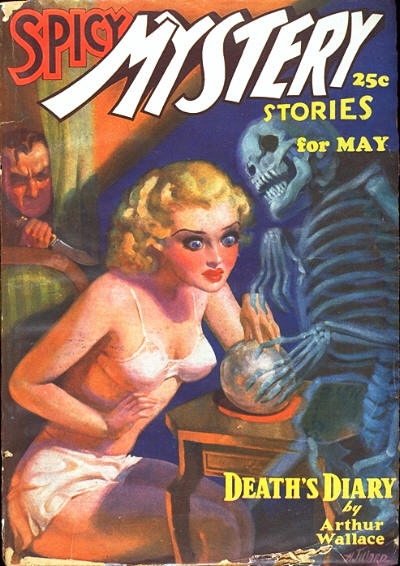
“Spicy Mystery Stories” was one of the Culture Publications pulps, and you just can’t get more ironic than that. The Spicies sold for a quarter and in most cities they resided under the counter. The cover art gave the game away. Sex, violence, and death all in one nifty semi-surrealist H.J. Ward painting. Dali should have been working for the pulps.
This issue, reprinted by Adventure House, is from May, 1936, and provides a terrific introduction to the world of weird menace storytelling. “Weird menace” is a particular subgenre of the horror story in which, generally, a gothic atmosphere is established, usually in a paragraph or two, and some sort of incredible danger is introduced. This danger will more than likely come in the form of a human monster, a zombie, a ghost, a being returned from the past, or just an all-round, slavering, lecherous, humanoid BEM. The kicker is that, as in the gothic novels that came before them and Scooby-Doo who came after, weird menace villains always turn out to be some demented-murderous-greedy yahoo who wants the mansion-fortune-beautiful gal all for himself.
This issue contains nine tales, all of which are fun. Each seems placed where it is in order to top the previous one in whacko plotting.
The first is “Death’s Diary” by Arthur Wallace, and it’s about a mad scientist who has developed a means of transferring a soul from one body to another. In a similar vein, Clint Morgan’s “Blood of a Dog” features another less than sane man of science, this one creating a fluid made from the essence of beast. Inject it into a human and the result is . . . what? In “She Who Was Dead” (nice title) by Jerome Severs Perry a beautiful, mad girl rises from the dead—or does she? Jerome Severs Perry was a popular penname for Robert Leslie Bellem, about whom more later.
Now we get to Mort Lansing’s “Green Eyes” and the plotting takes a turn toward the seriously bizarre. In this one, a mad painter (to give us a break from mad scientists) kidnaps people to contort their bodies into tableaux of torture of pain. Prospective patrons of the bloody arts wander through his gallery looking at these living mannequins of death and when they see a pose they like, they pay the artist to paint it for them. Eli Roth, I have a story you might want to take a look at.
In “Death Shows the Way,” by Tay Philips, a man escapes from an asylum to return to the place of his wife’s death only to find her three-year old corpse waiting in bed for him.
With “Cord of Cowardice,” by Cary Moran, we return to the relative normalcy of a man dressed as a medieval Viking who puts his wife’s death mask on a young woman so he can consummate his nuptials. Seems his virgin bride died before he had the chance three years ago.
In the brief “The Crowded Coffin,” by Dennis Craig, lovers pass along a disease that makes hair grow five feet a night and drains males of strength until they die. It’s Samson in reverse.
Finally we come to Robert Leslie Bellem under his real name, creator of Dan Turner, Hollywood Detective, and one of the bedrock writers of the Spicy line. In “Cavern of the Faceless,” a woman who has been scarred hideously in a beauty parlor accident (!) kills herself. Her husband then buys the place where her injury occurred despite the fact that four of the employees have disappeared. It appears that he is a mad revenger, but not only is this a weird menace story, but it’s a weird menace story by Robert Leslie Bellem. I can’t give too much away but trust me; wilder plots than this one, they just don’t write.
This issue concludes with John Bard’s “The Second Mummy,” a story about an American detective who is called by an old friend to Mexico to find a missing object d’art. This one has a nice punch in the ending.
Oh, and as for the “spicy” bits, here’s a typical passage from the Bellem story:
“With infinite tenderness, Kendrick Westfall pressed his mouth upon her parted lips. His hand stole upward along her side; his arm crept about her slim waist. As he drew her close, he could feel, through the thinness of her summery frock, that firm half-globe of sweet flesh, the ripple and play of her muscles—the tremor of her soft breast against him. His whole being ached with ecstasy at her response . . . “
We all know what those three dots at the end represent, and that’s about a titillating as it gets. The Spicies indulged in a little kinkiness, but it tended to be more underplayed than that appearing in such hard-cored weird menace titles as “Horror Stories” and “Terror Tales.”
I can’t dismiss this issue of “Spicy Mystery” by saying that the stories are silly. Of course they’re silly. Anyone over the age of 12 in 1936 knew they were silly. And the objection to that is . . . ?
This issue, reprinted by Adventure House, is from May, 1936, and provides a terrific introduction to the world of weird menace storytelling. “Weird menace” is a particular subgenre of the horror story in which, generally, a gothic atmosphere is established, usually in a paragraph or two, and some sort of incredible danger is introduced. This danger will more than likely come in the form of a human monster, a zombie, a ghost, a being returned from the past, or just an all-round, slavering, lecherous, humanoid BEM. The kicker is that, as in the gothic novels that came before them and Scooby-Doo who came after, weird menace villains always turn out to be some demented-murderous-greedy yahoo who wants the mansion-fortune-beautiful gal all for himself.
This issue contains nine tales, all of which are fun. Each seems placed where it is in order to top the previous one in whacko plotting.
The first is “Death’s Diary” by Arthur Wallace, and it’s about a mad scientist who has developed a means of transferring a soul from one body to another. In a similar vein, Clint Morgan’s “Blood of a Dog” features another less than sane man of science, this one creating a fluid made from the essence of beast. Inject it into a human and the result is . . . what? In “She Who Was Dead” (nice title) by Jerome Severs Perry a beautiful, mad girl rises from the dead—or does she? Jerome Severs Perry was a popular penname for Robert Leslie Bellem, about whom more later.
Now we get to Mort Lansing’s “Green Eyes” and the plotting takes a turn toward the seriously bizarre. In this one, a mad painter (to give us a break from mad scientists) kidnaps people to contort their bodies into tableaux of torture of pain. Prospective patrons of the bloody arts wander through his gallery looking at these living mannequins of death and when they see a pose they like, they pay the artist to paint it for them. Eli Roth, I have a story you might want to take a look at.
In “Death Shows the Way,” by Tay Philips, a man escapes from an asylum to return to the place of his wife’s death only to find her three-year old corpse waiting in bed for him.
With “Cord of Cowardice,” by Cary Moran, we return to the relative normalcy of a man dressed as a medieval Viking who puts his wife’s death mask on a young woman so he can consummate his nuptials. Seems his virgin bride died before he had the chance three years ago.
In the brief “The Crowded Coffin,” by Dennis Craig, lovers pass along a disease that makes hair grow five feet a night and drains males of strength until they die. It’s Samson in reverse.
Finally we come to Robert Leslie Bellem under his real name, creator of Dan Turner, Hollywood Detective, and one of the bedrock writers of the Spicy line. In “Cavern of the Faceless,” a woman who has been scarred hideously in a beauty parlor accident (!) kills herself. Her husband then buys the place where her injury occurred despite the fact that four of the employees have disappeared. It appears that he is a mad revenger, but not only is this a weird menace story, but it’s a weird menace story by Robert Leslie Bellem. I can’t give too much away but trust me; wilder plots than this one, they just don’t write.
This issue concludes with John Bard’s “The Second Mummy,” a story about an American detective who is called by an old friend to Mexico to find a missing object d’art. This one has a nice punch in the ending.
Oh, and as for the “spicy” bits, here’s a typical passage from the Bellem story:
“With infinite tenderness, Kendrick Westfall pressed his mouth upon her parted lips. His hand stole upward along her side; his arm crept about her slim waist. As he drew her close, he could feel, through the thinness of her summery frock, that firm half-globe of sweet flesh, the ripple and play of her muscles—the tremor of her soft breast against him. His whole being ached with ecstasy at her response . . . “
We all know what those three dots at the end represent, and that’s about a titillating as it gets. The Spicies indulged in a little kinkiness, but it tended to be more underplayed than that appearing in such hard-cored weird menace titles as “Horror Stories” and “Terror Tales.”
I can’t dismiss this issue of “Spicy Mystery” by saying that the stories are silly. Of course they’re silly. Anyone over the age of 12 in 1936 knew they were silly. And the objection to that is . . . ?
Subscribe to:
Posts (Atom)