Saturday, April 30, 2011

Unclean Cults: Land of the Lost and Howard the Duck


This week, two attempts to translate cult favorites to the language of film, with gibberish the results.


When do you first get the feeling that Land of the Lost is in trouble? Not counting when you first saw the trailer. When? Immediately.


In the movie's first post-title scene, crackpot scientist Rick Marshall (Will Ferrell) is flogging his new book on "The Today Show" and his interview with Matt Lauer, playing himself, isn't going well. Lauer gets the movie's first laugh and I wondered if Ferrell and director Brad Silberling really meant for Matt Lauer to set the pace.


Dr. Marshall believes that movement between dimensions and alternate universes is possible, but he doesn't attempt a field test of his tachyon gizmo until encouraged by Holly, a hot young science student from England (Anna Friel). They experience "the greatest earthquake the world has ever known" and, along with a redneck doofus named Will (Danny McBride) wind up in a place where anything dreamed up by sitcom writers can happen.


After flopping down on a patch of lost-land desert containing a Viking ship and what could be Amelia Earhart's plane, they meet Cha-Ka, a Sleestak, sort of a 2001 australopithecine reject (Jorma Taccone). From there, the movie is essentially a series of sketches and concepts, most of which don't work very well stretched out over 93 minutes.


So what do we get? Lots of aimless running and screaming—the farce's traditional demand for "louder, faster, funnier." Two of out three, anyone? There are some CGI dinosaurs. Several gags based on bodily excretions, especially numbers one and two. Some of the throwaway gags worked for me. As the tachyon gizmo first hums to life we see Dr. Marshall looking down at it, his face lit by a soft blue light. "It's beautiful," he gasps in a moment that perfectly parodies Paul Freeman's Dr. Belloq in Raiders of the Lost Ark just before his head melts.


If only TV writers Chris Henchy and Dennis McNicholas could have come up with more stuff like that, Ferrell wouldn't have to fall back on re-cycling his standard movie persona. Yes, earlier movie comedians have mined one character for all s/he was worth, but audiences saw them only once or twice a year. With basic cable, On Demand and DVD, we can see Will Ferrell, or any movie star, so often it's easy for them to become over-exposed.


Matt Lauer ends the movie with another solid laugh. Who knew? Maybe Land of the Lost isn't really a Will Ferrell picture at all. Maybe it's a Matt Lauer movie and Ferrell just hogs most of it. Maybe theyshould have cut out all that unfunny Ferrell stuff for the DVD. That would leave us with a five-minute movie full of LOL material instead of an intermittently amusing 93-minute one. Sounds good to me.


And now for something almost exactly the same, the movie equivalent of The Hindenburg crashing into the Titanic, the non plus ultra of big budget bad movies, the one, the only . . .


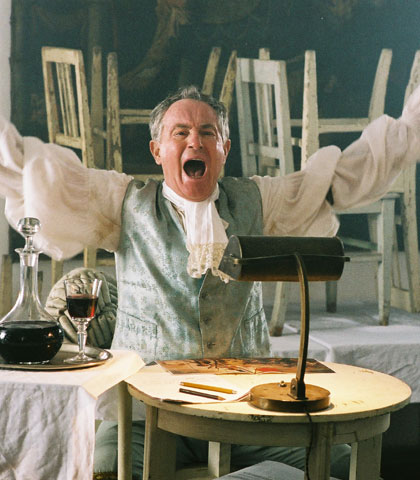
Howard the Duck.


Re-visiting older films you once panned is good for the critic's humility. You frequently find that The Movie in Question isn't as bad as you thought it was. Maybe that's because you've seen so many even stinkier floppiles since the initial viewing. Maybe you're just mellowing. Maybe senility is taking over.


Well, I'm here to announce that I am not mellowing and senility is not yet my dominant mental condition. Howard the Duck is just as bad as it ever was. Time has not blossomed nor custom improved its unique blend of over-production and cheap-jack special effects, nor its lousy acting, insulting script, and hapless direction. If you were watching "Jeopardy" and the category was "Rotten Movies," the correct response to every clue would be Howard the Duck.


Adapted from the super comic book created by Steve Gerber, this mess of a movie was produced by George Lucas, who apparently learned nothing from the derision he received over the little people in teddy bear costumes in Return of the Jedi in 1983 and allowed Ed Gale, whose subsequent career included stunt doubling Chucky in the Child's Play series, to don a risibly unconvincing duck suit. Howard, who is transported against his will from the Duck Planet to Earth, is supposed to be a master of Quack Fu but can barely waddle around.


Arriving on Earth, he is abused, laughed at and smacked around—no one has sense enough to grab him and rush him to the nearest Ripley's Believe It or Not Museum. Finally, he comes to the rescue of second rate rock singer Beverly Switzler (Lea Thompson) who takes him home with her and, maybe, falls in love with him. Together, and with the help of lab tech Phil Blumburtt (a hideously overacting Tim Robbins) they save the world from an invasion of Dark Lords of the Universe, led by a possessed Dr. Jenning (Jeffrey Jones).


The opening getting-to-know-you segment lasts way too long, the Dark Lords section is played too straight, and the film's last two reels are nothing but explosions, screaming, and the kind of stop motion animation that was amazing in King Kong but was sadly antiquated by 1986. The picture was directed by Lucas' buddy Willard Huyck and written by Huyck and Gloria Katz. Why the hell didn't they get Steve Gerber to at least chip in? The man, who died in 2008, was a terrific comic book satirist. Maybe Lucas and Co. were just set on turning out a family comedy instead of the R rated burlesque of comics, movies and life in general the picture would have had to be in order to duplicate the real Howard. The missed opportunity is as painful as a kidney stone the size of a duck egg.


But one good thing came of it all. The film's box office failure was so severe it forced Lucas to sell the Lucasfilm animation department in order to keep the rest of the empire afloat. He sold it to Steve Jobs and it became Pixar.


Howard the Duck was such a massive flop it must be seen to be believed, so take a look next time it shows up on cable—but for the sake of your soul, don't buy it. People have gone to hell for a lot less. Poor Howard deserved better than this. You will believe a male duck can lay an egg.



Thursday, April 28, 2011

Dark and Stormy Night (2009)


Charles Ludlam, late founder of the Ridiculous Theatrical Company, once wrote a play the dialogue of which consisted of the punch lines of old jokes. No, I don't remember the title. Jeez, do I have to do everything around here?


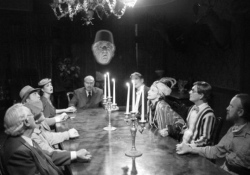
Larry Blamire, creator of one of this century's great cult classic films, The Lost Skeleton of Cadavra, pulls off something just as challenging and funny with Dark and Stormy Night, in which everything is a dark-old-house spook-movie cliché: plot, characters, props, setting — everything. The dialogue is a thing of beauty, comprised almost entirely of stream-of-unconsciousness non sequiturs. One character asks the butler to provide sherry for the guests, and "Bring me an iced tea sandwich."


The relatives — and assorted strangers, servants and one guy in a gorilla suit — have gathered for the reading of the will, then they start dropping like lead bon mots. Blamire's usual gang of thesps, with a quartet of guest actors who have been in movies you've actually heard of, deliver their senseless lines as if any of this had any meaning beyond tickling your nostalgia for Hollywood Poverty Row thrillers until it hollers, "Uncle!"


Blamire's talent for absurdist burlesque is immense and I'd like to see it rewarded with mainstream recognition, but if that meant he'd have to stop making these low-budget masterpieces, well, screw that. A wider multiplex audience could never love him like we do.


Sunday, April 24, 2011

The Marriage of Maria Braun (1979)


Director Rainer Werner Fassbinder, working from his own story, combines the names of the Virgin Mary and Eva Braun (Frau Hitler) to create a character that one critic said represented the postwar Germany of the "economic miracle"—dragging itself up from the hideous and shameful disaster of war to an attractive creature wearing jewels and expensive clothes, but totally without a soul.


Maria (Hanna Schygulla) marries her German soldier Hermann Braun (Klaus Lowitsch) as the world turns to a blasted outhouse around them. The Justice of the Peace tries to escape the bombing but the almost-married couple runs after him through the street, tackling him as explosions go off all around them, and force him to sign the legal document. The next thing we know, it's the following day and Hermann has been sent to the Russian front. Maria will say later that she is fully married—after the ceremony she and Hermann had a half day and a full night before he was shipped out.


After the war, her best friend Betti's (Elisabeth Trissenaar) husband Willi (Gottfried John) returns with the news that Hermann was killed. Maria chooses to disbelieve this story and determines to prepare for the day of her husband's return by accumulating as much money as possible. To this end she buys the best dress she can and becomes hostess at a bar catering to American occupation troops. Having learned to survive the war, Maria now has to learn how to survive the peace. She takes up with Bill (George Byrd), a black soldier and becomes pregnant by him. This affair ends suddenly in a character defining moment when Hermann proves her right by showing up again.


Even with proof of Hermann's survival, Maria follows in the footsteps of Bertolt Brecht's Mother Courage and continues to do what she needs to do in order to improve her situation and keep the money coming in. Brecht preached the gospel of survival at any cost—grub first, he wrote, and then morals—but even after she is able to support herself well, Maria seduces and then goes to work for half German, half French factory owner Karl Oswald (Ivan Desny) and becomes a partner with Oswald and his accountant Senkenberg (Hark Bohm).


Maria will be accused of cynicism, but in the world of German reconstruction cynicism is reality. "It's not a good time for feelings," she says. "And that suits me." Over lunch in a fine restaurant, Oswald fears she's grown bored and will soon leave him. She denies any possibility of unpleasantness. "You were brought up well," she says, "and I pretend that I was."


The film combines the rags-to-riches plot of American films like Baby Face with an eye for historical detail and the upscale melodramatics of Douglas Sirk, a German director who immigrated to Hollywood and made a series of silky women's pictures for Universal in the 1950s. That's not a criticism. Magnificent Obsession, Imitation of Life and All That Heaven Allows are as good as most other genre films of their time, and much better than most.


What Fassbinder and leading lady Schygulla add is a pinch of Dietrich from The Blue Angel. Maria only displays emotion when she wants to, whether she's actually feeling it or not. At one point late in the film, she shows up in her underwear, and it's an almost perfect dominatrix outfit. A touch of masochism has been noted in many of Fassbinder's men.


The Marriage of Maria Braun is the first movie in what is seen as a loose trilogy of pictures dealing with strong women finding out what it takes to live through Germany's 20th Century, one hundred years of national horror, humiliation and hubris. It's a key film in the movement known as "New German Cinema."


Wednesday, April 20, 2011

Casino Royale (1966)


I have no cinematic guilty pleasures, so when I enjoy a movie like the absurd James Bond burlesque Casino Royale, I don't feel guilty about it. I feel stupid, sure, but not guilty.


Cooked up by six directors (Ken Hughes, John Huston, Joseph McGrath, Robert Parrish, Richard Talmadge, led by Val Guest), and with three credited and seven uncredited writers — including such heavyweights as Ben Hecht, Woody Allen, Joseph Heller, Terry Southern and Billy Wilder — there's no way this could be anything but a train wreck, and that's what it is. But who ever said train wrecks weren't fun to watch? It's like that old Dennis the Menace cartoon in which the kid mixes root beer, ketchup, peanut butter, and assorted other gastronomic favorites into one concoction on the theory that if each one of them tastes good alone, blended together they must be super yummy. Sure.


Based on Ian Fleming's first 007 novel — yeah, like The Origin of Species is based on the Book of Genesis — the comedic premise is that Sir James Bond is called out of retirement to best SMERSH's financier, Le Chiffre (Orson Welles), at cards. Why? What, you're expecting a plot? Okay, if you insist: Le Chiffre has been gambling with SMERSH's money and British Intelligence wants to break him. Happy, now?


To confuse the enemy — not to mention the audience — just about everyone on the side of the good guys is called "James Bond," so David Niven, Peter Sellers and Woody Allen, among others, are all JBs. Sir James (Niven) also enlists the aid of his love-child daughter, Mata Bond (Joanna Pettet), and sexy spy Vesper Lynd (Ursula Andress).


Hating each other, Welles and Sellers refused to be on set at the same time, so their scenes had to be shot separately and then welded together. It must have been pure hell. The enmity, at its core, seems to have been the result of Princess Margaret (the Queen's sister) visiting the set one day and fawning over Welles while ignoring Sellers, who would hold up filming by disappearing for days at a time and was finally fired before filming completed. He was replaced by a cardboard cutout.


If only the whole movie could have been welded together. It's truly a near-incomprehensible catastrophe, but it's saved by being so stupefyingly mid-1960s. Watch for a cartload of cameo appearances, including ones from Peter O'Toole and William Holden, and the score by Burt Bacharach fits the idiocy perfectly, especially in the Berlin section.


It's the Berlin sequence, directed b y Ken Hughes (who would soon do penance by directing the film of Ian Fleming's Chitty Chitty Bang Bang two years later), that holds together best. In Berlin, Sir James visits the Mata Hari Dance and Spy School to see his daughter. The set design in the school is a pitch perfect parody of German Expressionism, as are costumes, makeup and (over) acting styles. Bacharach's bouncy Berlin theme sounds as if it would be right at home in a production of The Three Penny Opera. Such spot-on satire seems out of place in the middle of all this silliness, but it is a welcome moment of genuine comic filmmaking.


Maybe you had to be there in the mid-1960s to dig this psychedelic zaniness (one reviewer at the time called the film "an electronic vaudeville show") and if you were, you'll probably have fun going back for a couple of hours.

Sunday, April 17, 2011

Brass Monkey (1948)

This is a Brit version of a type of movie that enjoyed a brief vogue in America—the filmed radio comedy show. Fibber McGee and Molly, Edgar Bergen, Fred Allen, The Great Gildersleeve and Jack Benny all made movies like this, pictures that brought their radio personalities and supporting casts to the screen. They are almost universally disappointments to their radio fans, B movies with little of the charm that made the radio programs so much fun.

Brass Monkey stars "Britain's favorite Canadian," Carroll Levis. Levis moved to England in 1935 and ended up putting together and hosting talent shows for the BBC—"American Idol" in London for people who played Stephen Foster songs on the saw or "Flight of the Bumblebee" on the accordion. (In 1957, Peter Sellers played Wee Sonny MacGregor, host of a radio talent show in the wonderful farce The Naked Truth, aka Your Past is Showing. I wonder if the satire contained a poke or two at Levis.) Anyway, in this movie Levis, playing himself, and not too convincingly, is the stereotypical Canadian—colorless, boring, doughy, and totally lacking in anything that could even mistakenly be called charisma.

He's returning from a trip to the Far East when an old friend of his, Kay Sheldon (Carole Landis) gives him a brass monkey as a good luck charm. What we know and they don't is that the monkey is one of three from an ancient Buddhist temple in Japan that is worth a fortune. Kay got it from her crook fiancé Max (Edward Underdown). It's destination in London is a rare objects d'art shop from which it will be sold to a collector (Ernest Thesiger). It's all a farcical conglomeration of plot elements from The Moonstone, The Maltese Falcon, and probably half the Sexton Blake thrillers ever written.

The story is nonsense. If the movie has any interest for modern viewers it comes from the supporting cast. Herbert Lom is his usual dark and sinister gangster self, but without the comic edge he would display so well in The Ladykillers. Terry Thomas (without the identifying hyphen) plays himself, dropping in a couple of times to perform some unbelievably unfunny music hall turns. Levis-program regular Avril Angers is the funniest person in the movie playing her radio persona, a Dumb Dora whose dialogue is mostly malapropisms and non sequiturs.

This was American B movie actress Carole Landis' last film before her suicide at age 29. Landis was an attractive blond and the American performer who clocked more time entertaining the troops during the war than anyone else. She became depressed that her movies never seemed to rise above the B level or attract much critical respect. "You fight just so long and then you begin to worry about being washed up," she said. "You fear there's one way to go and that's down.
I have no intention of ending my career in a rooming house, with full scrapbooks and an empty stomach."

Directed by the American Thornton Freeland (whose only major credit is the Astaire/Rogers musical Flying Down to Rio from 1933), Brass Monkey is second rate in just about every category. When it isn't second rate, it's third. For the curious only.

Saturday, April 16, 2011

Bugs Bunny Superstar (1975)


It's possible to be a movie lover and not like Greta Garbo or John Wayne or W.C. Fields, and still retain some credibility — but turn your nose up at Bugs Bunny and hell hath no depth too deep for you, you humorless poseur.


Too harsh? Not harsh enough, doc.


Director Larry Jackson celebrated all things wascally with the documentary Bugs Bunny Superstar. It contains live-action footage of the cartoonists and their staffs acting out stories before the animation began — Tex Avery was a hoot — but it's mostly long on cartoons (a good thing) by including nine full-length examples from the 1940s, only six of which star Bugs. It's short on documentary factoids about the history of the character and the gang who created and developed him in a creaky building called Termite Terrace on the Warner Bros. lot.


This anecdotal back story material is presented to us primarily by Bob Clampett, one of Bugs' papas. The picture's worth watching for Clampett's hideous hairpiece alone. It looks like something Elmer Fudd might have shot on one of his hunting expeditions when his rifle misfired. He explains that a major reason the cartoonists caricatured the Warner Bros. stars they did was that those were the guys who stopped by Termite Terrace pretty regularly to see what was going on and to shoot the breeze with the animators and their staffs. James Cagney and Humphrey Bogart were favorite visitors.


Included also are snippets from vintage interviews with Friz Freling and Tex Avery. From Avery we learn where the question "What's up, doc?" came from—he was quoting someone he knew, just as a relative of his used to grumble, "Thanks for the sour persimmons, cousin," which found its way into Daffy Duck's vocabulary.


It's these reminiscences, especially from Clampett, that generated some hurt feelings when this film was released. While Clampett had complimentary things to say about Chuck Jones, Jones — who could nurse a grudge like Silas Marner could nurse a nickel — accused Clampett of being a credit hog. The thing is, when this picture was made, almost everyone from the days of classic animation was looking for credit for the work he'd done for hire in the 1930s-1950s, so a lot of exaggeration was going around.


But you can ignore this backstory and enjoy the film for the comedy it contains. Especially fun are the undeniable classics The Wild Hare (1940), A Corny Concerto (1943), My Favorite Duck (1942) and Hair-Raising Hare (1946). The movie is narrated by an obviously-in-on-the-joke Orson Welles.


My favorite from this collection is the Clampett directed A Corny Concerto. It's one of those 'toons that is all jolly good fun on the surface, covering at heart a wicked satire of Disney's 1940 Fantasia—just the sort of thing you'd expect from a Frank Tashlin script. It is divided into two parts, each part introduced with a brief appearance from Elmer Fudd playing a combination of Igor Stokowski and Deems Taylor. Wearing an ill-fitting tux and sporting a five-o'clock shadow that looks more like 9:30, he leads us through the music with observations like, "Wasn't that wovewy?" just before his flapping celluloid dickey snaps up and smacks him in the face.


The first story concerns Porky Pig and a dog hunting Bugs Bunny to "Tales From the Vienna Woods," and the second is a variation of "The Ugly Duckling" to "The Blue Danube." It's the duckling segment that contains the most blatant moment of Disney satire. When one of the characters whooshes past a pair of weeping willows, their branches whirl around frantically before the anthropomorphic trees end up hugging each other, an image that could have been lifted right out of a Silly Symphony.


For some reason, this isn't one of Clampett's favorites from among his own cartoons. Granted, it isn't as funny as his toupee, but it comes pretty damn close.

Tuesday, April 12, 2011

He Who Gets Slapped (1924)


April 1, 1883, is the birthday of Lon Chaney, whose stardom in movies puzzles many film lovers. How, they wonder, could a man with average looks, who never won the gal in the last reel, and who specialized in characters who were physically and psychologically repugnant have remained a box office giant for a decade? He was only 47 when he died on August 26, 1930, still at the peak of his powers and popularity. He made only one sound film, The Unholy Three (1930), and that was a remake of one of his silent successes. His two most famous pictures—The Hunchback of Notre Dame (1923) and The Phantom of the Opera (1925)—are more "known of" than watched.


But his fans, even today, are legion, and I count myself among them. To celebrate his career let's spend a few days looking at three of his lesser-known movies. We'll start with a picture that answers a trivia question: what was the first movie that used Leo the MGM lion as part of the studio logo?


In He Who Gets Slapped, Chaney worked with the great Swedish director Victor Sjostrom (Victor Seastrom in America). The film is based on the symbolist drama by Leonid Andreyev.


Chaney plays Paul Beaumont, a research scientist who has spent years working on an outré theory as to the origins of life on Earth. He and his wife Maria (Ruth King) are supported by the patronage of Baron Regnard (Marc McDermott, who made 195 films between 1909 and his death in 1928). But what Paul doesn't know about the Baron is that he is having an affair with Maria, and when it is time to present Beaumont's theories to the Academy of Science, the Baron claims them as his own, dismissing Paul as a starving student who was hired as a research assistant.


When Beaumont objects, the Baron slaps him and the members of the Academy laugh at his humiliation. Beaumont's grip on sanity has never been too secure, and when Marie spurns him with the words "Fool! Clown!" his fingers finally slip away and the abject figure makes the connection between getting slapped and generating laughter.


Seastrom concludes this episode by cutting to a laughing clown who watches a spinning globe, an image he will repeat to separate the film's sequences.


"With a supreme gesture of contempt," the intertitles tell us, Paul becomes a circus clown. Several years go by and the scientist, now known as HE, the clown, has become an international success. His act? Pontificating about the nature of the world to an academy of clowns and being knocked to the ground for his profundity. His clown/friend is Tricaud (Ford Sterling, best remembered now as the perpetually harried chief of the Keystone Kops), who reminds him that "There's nothing makes people laugh so hard as seeing someone else get slapped."


A down-at-the-heels Count Mancini (that brilliant character actor and eventual veteran of 197 movies, Tully Marshall), who is as much scam artist and blackmailer as he is minor nobility, enlists his lovely daughter Consuelo (Norma Shearer, whose 25th film and fourth pairing with John Gilbert this was) as an equestrian. She and her co-performer Bezano (a pre-Garbo John Gilbert) soon fall in love.


There is a visible ease to Gilbert's and Shearer's work together. Shearer was 22 but seemed younger; Gilbert was 27 but seemed older. Chaney was 41 but seemed older still. HE is also is love with Consuelo but the difference in their ages prevents anyone from seeing the depth of his affection for her. The theme of a psychologically or physically scarred older man in the thralls of unrequited love for a younger woman repeats itself in Chaney's films—Quasimodo and Esmeralda in The Hunchback of Notre Dame, Erik and Christine in The Phantom of the Opera, Sgt. O'Hara and Nurse Dale in Tell It to the Marines, Alonzo and Nanon in The Unknown, Tito and Simonetta in Laugh, Clown, Laugh. Chaney's woeful characters in these films pined for actresses as young as the 22-year old Joan Crawford, and Loretta Young, who was 15.


Just as we think that the pain of love will be HE's alone, the Baron returns to the story. Of course, he finds Consuelo fascinating and, dumping Marie with a large check and no kind words, the Baron strikes a bargain with Count Mancini for Consuelo's hand. Bezano is furious, but seemingly helpless when faced with such a powerful class distinction. HE, unrecognizable in his clown makeup, torments the Baron. "I hate clowns," the villain snarls. "I hate Barons!" HE snaps back.


Alone with her, HE confesses his passion for Consuelo, who is stunned and a little repulsed by this news. But HE is so serious, the young woman assumes he must be joking. She gives him a playful slap and laughs at him. Knowing that life holds little for him, HE devices a plan to rid the young lovers of the Baron and the Count, and Chaney's character, as they did so often, sacrifices himself for the normalcy of romance.


One of the legends that has grown up around Chaney's body-twisting performances is that the actor tortured himself to get just the right look. Certainly the legless Blizzard in The Penalty required some painful contortions, but stories about the weight of Quasimodo's hump and the hooks that were used to flare Erik the Phantom's nostrils are exaggerated or false. Perhaps these yarns were originated by studio publicity men, but I suspect they have been so readily believed because of the connection made by audiences between their entertainment and the masochism endured by Chaney's characters. He Who Gets Slapped is a clear statement that someone else's pain can be our pleasure, and that we are fascinated by the misfortune of others. To a large degree, isn't that the appeal of many movies?

Friday, April 8, 2011

Yojimbo (1961)


There is a sort of perverse existentialism at play in Yojimbo. A lone ronin (masterless samurai) walks into a small town. The buildings are just barely hanging together and the streets are dusty. If the place reminds viewers of the hardscrabble hamlets of the Old West, that's because American westerns, especially those of John Ford, were a powerful influence on director Akira Kurosawa's approach and visuals. The samurai, who, after looking out a window at a field of mulberries, will tell someone his name is Kuwabatake Sanjuro ("Mulberry Field thirty-year-old"), learns that the town is ruled by two criminal families. They are equally matched in strength and fighting ability—not to mention brutality, arrogance and stupidity—so their constant skirmishing prevents any kind of real progress, but keeps the coffin maker busy.


It's not hard to tell what kind of a place this is. One of the first things Sanjuro and we see is a dog running down the street with a human hand in is mouth.


Sanjuro realizes that he can rent himself out as a bodyguard (yojimbo), first to one family and then to the other, playing both sides against the middle until the two families wipe each other out. At first glance we may think he is doing this to free the town of its merciless bosses, but it quickly becomes apparent that his real goal is his own amusement. There is a tall guard tower in the center of town, with a warning bell at the top, and Sanjuro likes to climb to the top so his view of the stabbings and fist fights will be unimpeded. Like any good existentialist, he knows that any meaning he can find in life is merely in the living—but the only meaning that means anything to him is the macabre pleasure of siccing two rabid dogs on each other. As Popeye's pal J. Wellington Wimpy used to say, "Let's you and him fight."


He does perform on good, altruistic deed. A farmer and his wife have been separated by one of the clans and the wife turned into a pleasure girl for one of the sparing punks. The farmer and his son (maybe four or five years old) can only watch this happen for fear of death. Despite an apparent lack of affection or respect for this couple, and an equal disgust at the blubbering of the traumatized child, Sanjuro kills six men who have been guarding the woman, thereby allowing her to reunite and skip town with her family. When the villains discover what they consider to be his treachery, he is beaten almost to death.


When Sanjuro causes trouble resulting in people killing each other—and most of these minions seem far more stupid than evil—all goes well with him and he enjoys himself immensely. When he does a good deed, he gets the crap beaten out of him. As they say, no good deed goes unpunished.


Toshiro Mifune is Sanjuro, and he delivers the most natural performance in the film. Everyone else exists in the realm of caricature, but that may be due to conventions of Japanese comedy—it could even be a sly parody of John Ford's penchant for broad comic interludes in his westerns.


Yojimbo is Kurosawa's most popular movie in Japan. He and Mifune followed it up with a sequel, Sanjuro, which is even more a recognizable comedy. And I would be remiss if I didn't point out that Yojimbo was unofficially remade by Sergio Leone as A Fistful of Dollars. Leone's film looks like a blatant steal, but Kurosawa admitted that he had taken the plot from Dashiell Hammett's Continental Op detective novel Red Harvest. There is nothing new under the sun, whether it's a Son of Italy or the Rising Sun.

Obsessione (1943)


Being a long time fan of James M. Cain, I don't know why it has taken me so long to watch Luchino Visconti's adaptation of The Postman Always Rings Twice, Obsessione. Made in 1943, it beat Hollywood to the punch, the John Garfield/Lana Turner version of the novel not coming out until 1946.


Here's the plot: Giovanna lives in a shabby restaurant with her husband, the gruff and not terribly bright Bragana (Juan de Landa). One day a hobo named Gino stops in and cons Giovanna out of a meal. When Bragana catches him, the bum offers to perform some repairs around the place. He stays and he and the wife fall for each other, hard. He asks her to run off with him; she refuses; he leaves without her. They meet again in the city, decide they can't live without each other, and plan to murder Bragana. Nothing good comes from their crime.


Neither this nor the American movie packs the wallop the novel does, but the American film comes a little closer. Visconti's seediness is seedier than Tay Garnett's seediness and the garage/hash house in which the lovers meet is certainly hot and dusty, but leads Massimo Girotti and Clara Calamai, as Gino and Giovanna (Frank and Cora in the book) are not convincing as a pair so desperately in lust they are willing to do whatever it takes to stay together. Cain called it "the love knot" and it was the plot device that drags his protagonists to hell in this story and its literary doppelganger Double Indemnity, both of which were based in part on the Judd Gray/Ruth Snyder murder of Snyder's husband in 1927, a stupid crime so ineptly carried out, Damon Runyon dubbed it "the dumb-bell murder case."


Whether or not you believe in the kind of blind, ravenous passion that rips its victim's guts out is entirely up to you, but I didn't see it in Girotti and Calamai. Calamai is certainly an attractive woman and was a big star in Italian cinema of the time, but we see nothing in the way Gino reacts to Giovanna that is a convincing motive for murder.


I suspect part of the problem may be that Visconti wasn't particularly interested in the sordid crime part of the story. While Gino is separated from Giovanna he meets lo Spagnolo (the Spaniard), a street vender who preaches Marxism—but subtly enough to get around Fascist censors—and appears to have more than a fraternal interest in Gino. I sense that Visconti, a homosexual Communist, would rather have spent more time with Spagnolo (Elio Marcuzzo), a character who has no equivalent in Cain's novel.


The real attraction of the film is its look and feel. It is one of the earliest examples of neo-realism, the style Visconti pioneered and championed before moving on to the romantic luxury of films like Senso and The Leopard.

Tuesday, April 5, 2011

Violette Noziere (1978)


Perhaps the most unsettling thing about Violette Noziere (Isabelle Huppert) as a character in Claude Chabrol's film is that she is so ordinary. As you can see from her photo, the real Vilolette was no beauty; as you can tell from her story, she was no evil genius. She was just a plain girl in her mid-teens who lived a somewhat awkward life with her lower-middle class parents in Paris in the early 1930s, who slipped out and pretended to be older so she could carry on with older men. She met a slick, useless young man with whom she fell completely in love and to whom she gave money and emotional support. When he threatened to leave her, she poisoned her parents, killing her father and nearly killing her mother.


Her story is the kind of sordid affair that frequently inspired fiction by James M. Cain, whose protagonists also found themselves tied up with emotional Gordian Knots. But Cain's hapless lovers/killers were snakes, beguiling us with the intensity of their stares as they looked in each other's eyes—Violette is a lizard, a colorless Gila monster crawling along from moment to moment. She fascinates us not because we wonder how she can escape her fate or what will happen when her passion finally bursts forth, but because we know that she is neither imaginative nor smart enough to avoid slouching toward the guillotine.


The film moves along with the same relentlessness. The crime is not presented in the larger than life manner of a Bonnie and Clyde shootout, but just as another episode in another day in another life of silent desperation. Mother Germaine (Stephane Audran) seems to be always on the verge of admitting to herself that something is wrong in the way her husband, Violette's father Baptiste (Jean Carmet), relates to the girl. (We see Violette and Baptiste chatting casually as she is topless and he has a hard time controlling his eyes.) Violette visits her doctor, who tells her she has syphilis. When her parents find out about it, she convinces them that the only way she could have contracted the disease was by inheriting it at birth from them. They swallow her story and what she tells them is medicine. It's the poison.


We also spy on Violette with some friends of near her own age. They claim to be students but they do have plenty of time to hang out at cafes—the mall?—sipping drinks and conversing about nothing in particular. This is how she meets Jean Dabin (Jean-Francois Garreaud), the counterfeit millionaire who soon reveals his need for money and his entire lack of interest in earning it. Violette supplies it by stealing from her parents and blackmailing older men of her acquaintance.


It's remarkable that Chabrol is able to bleach all the sensation from what was one of the most sensational crimes of the Parisienne1930s and still keep us fascinated. Written by Odile Barski, Herve Bromberger, and Frederic Grendel, based on the book by Jean-Marie Fitere, the film is not the overheated crime, but the clinical autopsy. Director of photography Jean Rabier and production designer Jacques Brizzio remind us that things and places are not colorful and exciting merely by virtue of being historical.


There's a creeping ennui to Violette, a lethargic dullness which allows us to see life through the girl's eyes. Before she meets Dabin she feels trapped in her parents' bog of an existence and nothing really seems to matter to her. After she falls in love—if that is really what it is and not just a desire for love that is so strong because everything else is so weak—she has to follow the path of least resistance because that is the only way she knows how to go.


It's a fine and observant film, and an exhausting one.


A Cure for Pokeritis (1912)


I suspect that the very first joke about marriage went like this: Two cavemen met one day and the first one said, "Who was that giant ground sloth I saw you with last night?" and the second one answered "That was no giant ground sloth; that was my wife."


Well, it used to slay the boys at Lascaux.


The movies have provided a means of relating the marriage joke from the earliest days of fictional one-reelers. The image of wife-dom usually suffered most through these quick anecdotes, which is only to be expected since men were telling the stories. The onscreen husbands, played by almost every silent and pre-code talking comedian at one time or another, were just regular guys looking for a little extra-curricular fun. Their wives were the spoil sports, taking the idea of being a civilizing influence way too seriously.


The screen's first comedy team specialized in these mini-situation comedies. John Bunny and Flora Finch made something like 100 shorts for Vitagraph between 1910 and Bunny's death in 1915. Only a handful of these pictures survive. They weren't all domestic comedies but that genre dominated their output with titles like And His Wife Came Back, Mr. Bunnyhug Buys a Hat for His Wife, Thou Shalt Not Covet, and Which Way Did He Go? (in which Bunny's character is named "Mr. Henpecko")..


Bunny, a native New Yorker, was short and heavy while London-born Finch was tall and thin. After Bunny's death, Finch stayed in movies—her last role being an uncredited bit in The Women (MGM, 1939) before her passing in 1940—but she never again achieved anything like the popularity she'd garnered as Bunny's screen wife. Her post-Bunny comic chops are on display as Aunt Susan in Paul Leni's The Cat and the Canary (Universal, 1927)..


Bunny and Finch mark a good place to start looking at the marriage joke in early films because in at least one way they lived the joke themselves: they weren't really man and wife, but they hated each other anyway..


In the best known of their few surviving one-reelers, A Cure For Pokeritis (1912), they are George and Mary Brown. George enjoys a weekly night out with the boys for a poker session. Their meeting place is the clichéd masculine den of impropriety: guys are sitting at tables shuffling and dealing, their shirt sleeves rolled up and ties loosened. Many wear eye shades; cigars and cigarettes are plentiful. All the place lacks are a pool table and a sinister coachman to be Pinocchio's Pleasure Island..


George consistently loses at cards. This night, he even has to borrow trolley fare home. He staggers in late, disheveled and looking like he's on the far side of a two-week drunk. Mary is sitting up waiting for him, growing angrier each minute she's forced to wait. He arrives and swears contrition. He'll never play poker again..


A week later, one of his friends comes up with a plot. George will pretend to join a lodge called "Sons of the Morning" that meets every Wednesday night. Mary believes him—not the first mistake she's made in this marriage, including answering "I do." The scheme would work well if George didn't talk in his sleep. We are to assume that a) he's never done this before, b) Mary has never noticed it before, or c) we're not to think about it..


At this point, the second familiar element of the marriage joke becomes apparent: the wife's relative. Be they lazy, inept, greedy, vice-ridden, unemployable, smarmy, or just plain stupid, wifey's relations are the stuff of domestic misery. In this case, the bane is Cousin Freddie, a dandified wuss who flutters his hands and rolls his eyes as Mary fills him in on George's skullduggery. To make all husbands in the audience like this guy even less, he enlists the aid of his Bible class in spying on George. How much less of a real man can you be than a Bible study participant?.


The dénouement arrives after heaping helpings of deceit, disguise and distrust. Apparently George has learned the lesson Mary set out for him. All will end well with George and Mary embracing. What hubby doesn't know is that Mary is responsible for breaking up his poker gang by uncovering his deception and then going him one better. Each of them is a trickster and neither really has any reason to believe the other. The loving clinch at the end is merely convention. We all know that if George can come up with another trick, he'll use it to reorganize his poker night..


We're also left to ponder this question: why does Mary go to such lengths to break up George's fun? Yes, he loses every week but we see nothing that indicates his poker losses are doing anything to undermine the Browns' financial stability. He's not stealing to cover his debts. He's not contemplating taking any winnings to run off with the office steno girl. The missus seems to want to put a halt to his night out just because it is his night out. Maybe she wants to make the emasculation complete by having him take up studying the good book, like Cousin Freddie..


Just as with a stand-up joke, there is no back story to this little movie. Mary does what she does because it is in the nature of wives to prevent their husbands from having any fun that doesn't include them—which from the male point of view is no fun at all.

Sunday, April 3, 2011

Sweeney Todd (1936)


The world-sweeping rage of Sweeneymania that Warner Bros. hoped for with the 2007 release of Sweeney Todd, the Demon Barber of Fleet Street didn't occur. The film's mix of black humor, unhumable melodies and blood-drenched melodrama didn't attract either the audience for musicals or the fans of gore. Perhaps the DVD availability of a solid 2006 BBC production starring Ray Winstone was another trip wire on the stairway to paradise.


But there was an earlier movie version of the story, much different in detail than the Tim Burton film. Its star was Tod Slaughter, Britain's answer to Karloff, Lugosi and Hollywood's other actors of the macabre in the 1930s. The puzzlement of Tod Slaughter's films, as even his most enthusiastic fans have to admit, is this: are his peculiar performances enough to let us recommend his movies when "by any objective standard they are cheaply-produced rubbish." (britishpictures.com).


If you want to try one, Sweeney Todd should be it. The long journey of Sweeney Todd from blood and thunder stage melodrama to Broadway musical began in an urban legend. One of Sweeney's stops along the way was a "quota quickie," a movie made in England on the cheap with at least 75% of the paid cast and crew being English. These came about because of the 1927 Cinematograph Films Act, which was enacted to help the British film industry compete with American movies at home.


Slaughter was born in 1885 so by the time he made Sweeney Todd in 1936, just his third picture, he was already in his 50s. He'd spent his early years on the provincial stage, touring England in the kind of be-whiskered melodramas much beloved by the Victorians and kept alive by shamelessly barnstorming theater companies. George King, a producer and later director of quota quickies, discovered Slaughter and decided that he would be as successful in films as he was on stage if he performed in the same kind of story, and so cast his new aging star in Murder in the Red Barn. It clicked with less demanding audiences and Slaughter began his cinematic reign of terror.


In Sweeney Todd, Slaughter plays the title roll of a demented barber in Victorian London who uses a tricked-out barber's chair to "polish off" his wealthier customers. A gentleman sits in the chair, Todd pulls a lever, and the chair and platform on which it rests swivel backward dropping the victim through a hole in the floor and into the cellar. If the fall doesn't kill him, Todd soon will.


The barber shop shares its cellar with the shop next to it, Mrs. Lovatt's bakery of meat pies. The movie never explicitly points out that Mrs. Lovatt (a deliciously pinched-face Stella Rho) cuts up the bodies of Todd's customers and bakes them into her pies, but several hints are dropped along with the corpses. In one scene, a supporting character is eating one of the pies as he ponders on why the corpses of the murdered men are never seen again. Either cannibalism was a taboo that could never have gotten past the censor or it was assumed that the British public already knew what the Todd/Lovatt connection was.


As the film opens, a solid British sailor named Mark Ingerstreet (Bruce Seton) is being greeted on his return from the sea by Johanna, his one true love (Eve Lister). Unfortunately, Mark sails for Johanna's father, one of those Victorian paters who would never consider a mere employee to be an acceptable suitor for his daughter's hand (D.J. Williams). Yes, dammee, it's too bad. We see Todd standing in the shadows, watching for a likely customer he can murder and rob. "I love my work," he cackles, slapping his hands together and wringing them. "Money!" he hisses with all the subtlety of an ocean liner hitting an iceberg when he sees a wealthy nabob come ashore.


Todd invites the man into his shop for a close shave and before dropping him through the hole in the floor, he sends his young apprentice Tobias (Johnny Singer) next door for a pie. As fate, and melodrama, would have it, Todd knows Johanna's father and wants to invest in his next voyage. Of course, he also has his beady eyes on Johanna and determines to win her either through wooing or through skullduggery, preferably the latter. (I am reminded of the fella in You Can't Cheat an Honest Man who asks Larson E. Whipsnade (W.C. Fields) if he wants to earn an honest dollar. "Does it have to be honest?" Whipsnade replies.)


Weeks pass and Mark sets out on the very voyage in which Todd has invested. The film now offers a diversionary segment in which the captain of the ship is killed by rampaging natives and Mark assumes command. When he returns to London he has with him a sack of pearls (hence the story's title, The String of Pearls, in its original penny dreadful incarnation in 1846).


Todd sees him disembark, lures him to the shop and attempts to kill him. This time, the fall doesn't "polish him off" and, after Mrs. Lovatt spies Todd stealing the pearls so he won't have to divvy up with her, she helps Mark to escape. Mark then decides to disguise himself as an old country farmer and goes back to Sweeney's shop. He's dropped into the cellar again and with the assistance of another sailor he figures out exactly how Todd performs his evil deeds.


Now we get to the wild-as-a-March-hare conclusion. Johanna discovers what Mark is up to so she disguises herself as a young boy and goes to Todd's in case she needs to rescue Mark. Todd figures out who she is, knocks her out, and locks her in the closet. He has already killed Mrs. Lovatt, offstage, and in order to cover up his crimes, he sets fire to the shop. Back rushes Mark and smashes his way into the building to look for Johanna. As he pulls her from the closet, Todd returns to kill him. Todd ends up in the blazing cellar, Johanna ends up in Mark's arms, and the ill-gotten gains end up spilled in an alley.


It's been said that if the Victorians could have made movies, the product would have looked like Tod Slaughter's pictures. Obviously, there isn't much in the plot to attract anyone born after 1902 and the production values (except for the costumes) are laughably low. The acting from the supporting players is actually a notch above what you find in poverty row American films of the era—but then there's Slaughter.


He's so hammy his performances should have been condemned in Leviticus. His smile is so wide you know his characters have to be faking their bonhomie, and the smile is never reflected in his eyes, which are unmoving and dead. He does a great deal of acting with his hands, double gesturing, wringing, and rubbing palms together. He often speaks in a throaty, raspy whisper that makes him sound like the host of a radio horror series. He doesn't seem to have figured out that you don't have to play everything so broadly in front of a camera.


But there's no denying that Slaughter is a one-man time machine. Watching him transports you to another era. In fact, you may find yourself hissing the television. I suppose, though, that the real pleasure comes from watching a performer who seems to genuinely love what he's doing. I know a critic shouldn't try to slide by with saying, "I can't explain it any better than that," but hell, I can't explain it any better than that.


Let me go out quoting britishpictures.com once again. "A new generation of fans have stumbled onto his work [seeing it on late night British TV] and asked the question 'What the bloody hell was that!'"


What indeed. So is this version of Sweeney Todd's gruesome journey a good movie? Oh, hell no. As a work of cinema, it's abysmal. Okay, do I recommend it? I just can't. I want to, but I can't. But if you've read this far, you know I recommend Tod Slaughter. Forget what I say and read what I mean. Seek him out.

Friday, April 1, 2011

Bubba Ho-tep (2002)


"Come and get it, you undead sack of shit."


If your taste runs to oddball concepts but away from horror movies, go with this one anyway. There isn't that much in it of a horrific nature—there's a re-animated mummy who sucks the souls out of aging convalescent home patients through their assholes (yes, another one of those movies), but the soul-sucking takes place off screen. Bruce Campbell stars as an old Elvis Presley, probably, although he could be an Elvis impersonator named Sebastian Haff, and Ossie Davis co-stars as Jack, who thinks he's John F. Kennedy dyed black and hidden away in an East Texas nursing home by Lyndon Johnson. When the home both men live in becomes besieged by the mummy, these guys know they have to protect the defenseless.


Written for the screen and directed by Don Coscarelli, and based on a short story by Joe R. Lansdale, the picture is as peculiar as it sounds, but it isn't a horror satire a la The Lost Skeleton of Cadavra. It's mostly humorous, but it's also a study of aging, missed opportunities, and the shabbiness of pop culture celebrity.


Both leads are terrific and they work together wonderfully. Davis was 84 when he made the film, which alone proves the movie's point about the retention of value in old age, and Campbell is so good as a grouchy King it makes you wish the guys who hand out acting awards weren't such clutch-butts.

Thursday, March 24, 2011

Re-Animator (1985)


"Who's going to believe a talking head? Get a job in a sideshow."


I don't know what was in the water in 1985, but I could sure use a glass of it now. Come on, August 16 brought us RETURN OF THE LIVING DEAD, and two months later RE-ANIMATOR came along. Laugh? Brother, you'll just die.


Herbert West is a third-year student at the Miskatonic University Med School. His specialty is death—or more correctly, the reversal of same. His roommate Dan Cain agrees to help him with his experiments but things get out of hand and pretty soon the rest of the cast is killed and brought back to life, and killed again, and so on.


Jeffrey Combs became a horror icon as West, Bruce Abbot is a wonderfully frazzled Dan, Barbara Crampton enters the Scream Queen Hall of fame as Dan's girlfriend (the Dean's daughter), and David Gale becomes the maddest scientist of all time.


Written by Dennis Paoli, William Norris and director Stuart Gordon, the film has everything from a dis-embodied head going down on a bound, naked coed to a cameo by James Cameron's father. It's a high-gore-level gumbo of sick humor and creepshow parody served up by those mad missionaries from the Church of Splatter Day Saints.


Fans of ZOMBIELAND should definitely check it out, but don't think that the relatively tame gore of the newer film will in any way prepare you for the floor-to-ceiling ick of this masterpiece. And there's the added bonus of the scrumdiddilyumptious good-sport nudity of Ms Crampton.

Thursday, December 2, 2010

Five Star Final (1931)


The newspaper business took a beating on stage and screen during the late 1920s and early '30s in plays and films like Ink, Man Bites Dog, Front Page Woman, Chicago (remade in 1942 as Roxie Hart), and most famously The Front Page. The height of the press' infamy was epitomized by the ghastly snapshot of murderess Ruth Snyder dying in the Sing Sing electric chair on January 12, 1928. Working for The New York Daily News, reporter Tom Howard strapped a cheap camera to his leg. Just before the juice hit Snyder, Howard bent forward, pulled his pant leg up and clicked the pic of the husband-murdering 33-year old sighing "Goodbye, cruel world." James Cagney's Danny Kean pulls the same stunt in Picture Snatcher (1933).

One of the angriest of the yellow-journalism productions was Louis Weitzenkorn's play Five Star Final. Time reviewed its opening on Broadway like this, in an unsigned piece dated January 12, 1931—interestingly, three years to the day after Ruth Snyder's execution: "Five Star Final is this season's newspaper play. But, unlike its more cynical predecessors, it is an earnest paean of hate directed against tabloid journalism. The play has undeniable vitality and provides a good deal of technical information on the inner workings of a gum-chewer sheetlet."

The play and film should be technically accurate. Author Weitzenkorn was at one time editor of the New York Evening Graphic (nicknamed by more responsible journalists the Porno Graphic). The Graphic was the most sensational of all the tabloids during its brief existence between 1924 and 1932. It went out of business because an editor tried to clean up its image and New Yorkers quit buying it. Weitzenkorn began his career as a reporter for the New York Times in 1919. He died in 1943 when he managed to set himself on fire while making a pot of coffee—a tab story if there ever was one.

Five Star Final was adapted for the screen by Robert Lord and written by Byron Morgan. Directed by Mervyn LeRoy, it was nominated as Best Picture of 1931 (losing to Grand Hotel).

In the movie, the Evening Graphic has become the Evening Gazette. The picture opens as a pair of goons on the paper's staff trash news kiosk because the owner refuses to put the Gazette on the top of the newspaper stack. These guys are not aiming to help win a Pulitzer. In the Gazette offices, the paper's owner Bernard Hinchecliffe (Oscar Apfel, who appeared in 163 films from 1929 to his death in 1938) complains about Editor-in-chief Joseph W. Randall (Edward G. Robinson) printing cables from the League of Nations instead of featuring photos of girls in their underwear. "We're losing the bubble gum trade," Hinchecliffe snaps, and Randal responds by calling his publisher the "Sultan of Slop." The argument is ongoing and seemingly without end.

"There's some guys who furnish the manure and some guys that grow the flowers."

Soon a reporter-hopeful comes to Randall. She's Kitty Carmody (Ona Munson, Belle Watling in Gone With the Wind), a sexy little trick from out of town. "He knows I've had a lot of experience in Chicago," she boasts to Randall's secretary. Miss Taylor (Aline MacMahon ) glares back "Yeah, you look it."

The next time editorial meets to plot out where they want the paper to go in the days ahead, the subject of a recent love nest murder comes up, which reminds someone of the 20-year old Nancy Voorhees case, in which a cute young stenographer fell in love with her boss and ended up pregnant. When he refused to marry her, she killed him. Randall agrees to run a serial rehash of the case as a cautionary tale. If a girl gets into trouble, it's decided, the paper should interview her mother. If the mother had told daughter the facts of life, this will be a warning to daughters. If she hadn't, it's a warning to mothers. Either way, the paper has performed a good deed for society.

Randall wants to introduce every installment of the story with a few paragraphs from a clergyman, so he calls on the Rev. T. Vernon Isopod, and this is where Boris Karloff enters the picture.

Isopod is one of Karloff's most unusual characters. He now works for the paper but was once a divinity student who got kicked out the seminary for sexual misconduct similar to that of Nancy Voorhees' old boss. He wears a black suit and hides behind empty eyes. "You're the most blasphemous looking thing I've ever seen," Randall tells him. "It's a miracle you're not struck dead." He's oily and unctuous, as sincere as a cut-rate mortician, but can hardly keep his eyes off of Kitty Carmody's legs. (Later, the two of them will share a ride and Kitty tells Randall, "I rode in a taxi with him and I darn near don't have any skin on my knees." Randall asks sarcastically if the two were praying together.)

Passing himself off as a real minister, Isopod talks his way into the apartment of Nancy Voorhees, who is now Nancy Townsend (Frances Starr). When he enters the flat, his eyes dart around as if he's trying to memorize every detail. He's not sure why Nancy and her husband Michael (H.B. Warner, who played Jesus in the silent King of Kings) agreed to see him, but soon figures out that they think he's connected to the wedding of their daughter Jenny (Marian Marsh, Trilby in Svengali) to the socially elite Phillip Weeks (Anthony Bushell, Ralph Morlant in The Ghoul) the next day.

Isopod solicits information from the Townsends they would never willingly give a reporter, and even makes off with a photo of Jenny. As soon as he leaves, the parents realize what they've done. They know that if Nancy's past is publically dredged up, it will ruin Jenny's chances for marriage and happiness. No one, not even Jenny, knows Nancy's story.

When Isopod returns to the office drunk, his eyes are heavy and deader than ever. His lisp is slurred. "This murderess," he manages to get out, "is marrying her daughter to an innocent boy. I was shocked!"

Pleading on behalf of the two newly-weds-to-be is of no avail and Nancy and Michael can't face the future. Isopod, who is corrupt to his core, comes up with the idea that the Gazette can pay Jenny for permission to turn her mother's tragedy into a faked "My Story by Nancy Voorhees" 1st person narrative.

The film's final shot is of a copy of the paper, bemucked in a gutter.

Karloff is in the opening credits as the eighth lead, but his significance to the plot and general atmosphere of newspaper hypocrisy and sleaze is invaluable. His patented gauntness and Uriah Heepish servility—repeated 15 years later as Master George Sims in Bedlam—add a touch of genuine creepiness to an essentially realistic story. You come away from the film not only despising the paper for what it's done to the Townsends, but for hiring people like Isopod to make certain it gets done. This is one of, incredibly enough, 16 movies Karloff made in 1931, including a 12-part serial, a Wheeler and Woolsey farce, and that little monster flick over at Universal. And to think that some folks don't even watch 16 films in a year.

"My wife has good taste," Karloff once told the press. "She has seen very few of my movies." Hopefully, Five Star Final is one of the exceptions.

Thursday, September 30, 2010

Never Take Candy From a Stranger (1960)


This may be the creepiest movie you've never seen. Made by Hammer Film Productions, it isn't one of their gothic romps. Those pictures are a lot of fun and you can enjoy yourself immensely either pretending to be scared or just wallowing in their nostalgic glow, but this one is a different manner of ick entirely.

Based on a play by Roger Garis called The Pony Cart, and with a screenplay by John Hunter and direction from Cyril Frankel, Never Take Candy From a Stranger (aka Never Takes Sweets From a Stranger), the film is the story of Peter and Sally Carter, with their pre-adolescent daughter Jean (Patrick Allen, Gwen Watford, Janina Faye) who have moved to Canada so Peter can take up the post of headmaster at the local high school.

One night, Jean tells her parents that she and her friend Lucille (Frances Green) had visited the Olderberry mansion because Lucille knew there was an elderly man there who would give them candy. Clarence Olderberry, Sr. (Felix Aylmer) promised to give the girls sweets if they would remove all their clothing and dance for him. The girls do (all this is offscreen) but now Jean is worried because she knows they shouldn't have done it.

When the Carters complain to the police they are told that the Overberry family owns the town and it's best to just forget about the old man's little problem and warn Jean never to visit him again. The Carters want more, for the sake of all the town's children, and force the police to bring Overberry to trial, where the defense counsel (Niall MacGinnis) twists everything Jean says on the stand and makes her look unreliable, at best.

Overberry is acquitted, as the Carters were warned he would be, and before they can move out of town Jean and Lucille go walking in the woods, and guess who they meet? His pursuit of the girls through the woods is chilling, mainly because Alymer, as Overberry, never speaks a word throughout the film. His aging pervert is not so much evil as he is stuck mentally in an evil place. He could easily be in the throes of early dementia. He shakes, he dribbles, he smiles vacantly, and when he sees little girls, he desires one thing only.

If the film were merely the story of a sexual predator on the prowl for children ("merely"?) it could easily be dismissed as exploitation of the worst kind—what a lot of viewers would expect from Hammer. But it's a true horror movie, the horror enhanced by the town's willingness to take chances with the lives of children if it can keep the factory open and the citizens working. This is a plot device that has become familiar in scary movies—think of the mayor insisting on the beaches staying open in Jaws—but, somehow, adults getting eaten by a fish is less upsetting, and a lot more playfully entertaining, than an elderly child abuser terrorizing young girls.

Monday, September 13, 2010

Lunacy (2005)


If you're looking for a pleasant night out to help your mom celebrate her birthday, unless she's Irma Grese, the Bitch of Belsen, you better look elsewhere.


On the surface, Jan Svankmajer's surrealist black comedy is about a man who may or may not be insane and his adventures with a Marquis who may or may not be insane as they tour a madhouse run by a staff that may or may not be insane. Odds are that they're all lunatics, but that's just my opinion and, according to this movie's underlying point of view, I may or may not be insane, too.

We tend these days to use some variation of the word "surreal" in place of "it was weird and I don't have a clue what it meant." You know, like an off-the-cuff joke from George W. Bush.

But sometimes "surreal" still refers to an avant-garde art movement, and that is the surreal that describes writer/director Jan Svankmajer's 2005 film Sileni—Lunacy, to you non-Czech speakers.

The film opens with a brief prologue in which Svankmajer addresses us directly, telling us that we are about to see a horror movie, with all of that genre's attendant degeneracy. He warns us that he has borrowed motifs from Poe—he calls his movie an "infantile" tribute to the American gothicist—and adopted the blasphemy and subversion from the Marquis de Sade.

We join the film as a young man named Jean is having a nightmare in which two bald and burly sanitarium attendants are smilingly attempting to put him into a strait-jacket. This dream incorporates some stop motion animation of a shirt crawling across the floor. Many of the film's most intense moments are interrupted by this animation, usually consisting of tongues and eyeballs cavorting on their own to the accompaniment of carousel music.

Jean soon meets the Marquis, an 18th. Century man in the 21st. Century world. Jean is invited to stay a few nights at the Marquis' castle. He accepts, but when he spies the older man conducting a blasphemous parody of the Mass one night, complete with naked altar servers, he decides to take the innocent village maid the Marquis seems determined to corrupt and run away with her.

Instead, he is talked into accompanying the ignobleman on a tour of the local insane asylum where he finds out that the innocent maid is in fact the head nurse. She tells him that the chief doctor and the Marquis are actually inmates who led a mutiny. Now the real hospital staff is locked in the underground dungeon and the loonies are in charge.

By the time the story ends, if it does, telling who's insane and who's lying is impossible so we settle for believing that, as in Alice in Wonderland—a story Svankmajer filmed in 1988—we're all mad here.

It's clear that Svankmajer sees the madhouse as a suitable symbol for modern life. One of the doctors believes in severe corporal punishment and one believes in letting the patients do whatever they want to do. Conservatism and Liberalism, anyone? But since nothing works, who cares?

There is much black humor at work here, and despite the claim that it's a horror movie, Lunacy is never scary on a visceral level. If it creeps you out, it'll probably be due to self-recognition. This observation does not apply to me, of course.


White tie is optional. Strait-jackets are required.

Friday, September 10, 2010

In This Our Life (1942)


Few things in nature are more wonderful and terrifying than a Bette Davis character in the throes of pure petulance and malice. That being the case, you can't do better than spend an evening with In This Our Life.

This was John Huston's second directorial assignment and while he doesn't seem as close to this material as he was to the hardboiled milieu of Dashiell Hammett's mean streets in The Maltese Falcon, he's having one helluva good time with Ellen Glasgow's southern gothic lite as scripted by Howard Koch.

The story takes place deep in the heart of The Land of Sociopathic Women. Davis is Stanley Timberlake, one of old Asa Timberlake's (Frank Craven) two daughters. Olivia de Havilland is the other one, Roy. The male names are not explained in the film and I haven't read the source novel. As the film opens, Stanley is about to be wed to a champion-of-the-oppressed local lawyer, Craig Fleming (George Brent). At the last minute, and for no apparent reason, Stanley abandons Craig almost at the altar and runs off with Roy's husband, young Dr. Peter Kingsmill (Dennis Morgan, who acquits himself nicely and may come as a surprise to viewers who know him only from his musical roles).

Stanley and Peter leave town and Peter gets an intern's position at a hospital. His salary is meager and his new wife is quickly and easily bored. Her constant nagging leads Peter to take Drastic Action, and soon Stanley is back home, where by now Roy and Craig have become an item. These southern girls don't let the grits grow under their feet, by cracky.

Of course, Stanley sets out to re-capture Craig and there is some chance that she may be able to do it. She makes an appointment with him to meet at a bar that night at 7:00. While waiting, she tosses back a few and when he hasn't shown up by 7:30, Stanley speeds off in her roadster. We've been told that she drives too fast and now we find out that with a few drinks in her she's capable of hit and run driving. When the cops find out that the car involved was hers, she tries to put the blame on Parry Clay (Ernest Anderson), the son of the Timberlake's black maid Minerva (Hattie McDaniel).

The other major player is the Timberlake girls' grating Uncle William (Charles Coburn). William is their maternal uncle and it's well known that he partnered in his brother-in-law's tobacco company, then forced Asa out. Now he enjoys calling on the Timberlakes in their modest house and rubbing everyone's nose in his dishonorable success. His only fan appears to be Stanley, who flirts with him because he's the rich relative.

Coburn was 65 when he made this picture and Davis was 34, and still the characters play the "I've got a surprise for you in one of my pockets and if you find it you can keep it" game. It's creepy, no doubt about it.

The picture is a hoot, with everyone playing just one notch above where people actually exist—not close enough to reality to turn this into drama but not so far up the wall that the whole thing becomes more camp than a field full of tents. Every time I watch this one, I'm wearing a huge grin on my face.

Friday, June 18, 2010

The Screaming Skull (1958)

Recent DVD and theatrical releases of movies by Dario Argento have started me thinking about that oddball breed of cinema we know as "cult movies," or "guilty pleasures." I'm one of those people who don't usually use the latter term because if I enjoy a movie I don't see any reason I should feel guilty about it. Hell, if I felt the need to apologize every time I enjoyed The Lost Skeleton of Cadavra or a Wheeler and Woolsey comedy, I'd be more weighed down by guilt than Judas Iscariot wearing an SS uniform while clubbing baby seals with a burning cross.

Actually, not all guilty pleasures are cult movies. To be a cult movie, a picture has to be appreciated by a number of people and is generally thought to be "so bad it's good," making cult movies at least a subset of camp. Guilty pleasures—or as I like to call them, "what I watch on Friday nights"—may be totally unrecognized by others and don't have to have any redeeming qualities whatsoever beyond the perhaps perverse pleasure they provide for me personally.

I've thought many times that I'd like to write a series of pieces—part reviews, part criticisms, part appreciations, part apologetics—on these movies from closer to the bottom of the cinematic barrel in hopes of scamming, uh, encouraging you to cultivate your inner movie slob. No, seeing every new Adam Sandler movie on its first weekend of release doesn't count. That's just conformist bad taste and I know you can do better than that.

Let's begin 50 years ago, at childhood, that time in life when a person's tastes—good and bad—are formed. The theater is The State, on the square of the small Texas town in which I grew up. The State played "B" movies and, on Saturday mornings, pictures in Spanish for the farm workers who came into the city for a few hours. But what I loved there best were horror movies like …

The Screaming Skull (1958)

You can tell which schlockfest "B" horror movies manipulate the basic accoutrements of the genre best by the degree to which they scare the bejeezus out of small children, and one of the things that has great power to create a seat-wetting problem is the human skull. You don't even have to give the ridges over the eyes that Harryhausen touch to make them look more sinister, but it can't hurt.

I had just turned nine when I saw The Screaming Skull for the first time, and it scared the breath out of me. Fifty years later I can still remember being so frightened I couldn't yell. Ah, those were great times … Macabre came along later that same year, with House on Haunted Hill and The Tingler (both 1959) soon to follow. We adolescent horror hounds, readers of "Famous Monsters of Filmland" all, were convinced that William Castle was the greatest filmmaker of all time. Even Psycho (1960) couldn't pull us away as it was a little too adult—but we still read everything by Robert Bloch we could get our sweaty little hands on.

I don't know if journeyman actor Alex Nicol, who directed The Screaming Skull in an effort to expand his career possibilities, could have beaten Castle into our hearts had he continued to make shockers. (Can you imagine a grown man still considering such a question? Neither can I.)

I've re-visited TSS several times over the decades. It used to show up on late night TV with some regularity, until even the tube outgrew such hack work, and more than one DVD distributor carries it in the catalogue. No, the original fear is long gone—I wish I knew a nine-year old I could convince to watch it in a dark room just to check out the reaction—but the memory is intact.

In the film, a newly wed couple come to the house the groom lived in with his former wife, the haunting Marion, who died in a sudden thunderstorm when she slipped on a wet leaf and stumbled by the lily pond, cracking her head open on a stone wall and then drowning. I'd think that this plot construct was an accidental reference to Ibsen's Rosmersholm except for the fact that composer Ernest Gold—yes, the same man who would win an Oscar for scoring Exodus in 1960—borrows the same brooding Sabbat theme from Berlioz' Symphonie Fantastique Stanley Kubrick used in The Shining (1980).

Maybe this movie is smarter than it has any right to be. John Kneubuhl, who would later write the "Pigeons From Hell" episode of Boris Karloff's TV program Thriller, wrote the script based on the legend of the screaming skull of Bettiscomb Manor, in England.

But setting references to classier stuff aside, Eric and Jenni Whitlock attempt to settle into the house. As he introduces her to the grounds, Jenni spots a small outbuilding and asks what it is.

"That's where Mickey keeps his gardening things," Eric replies.

"Who's Mickey?"

"The gardener."

Or maybe the movie isn't any smarter than it has to be. But you know that feeling you sometimes get, the feeling that the filmmakers are playing around a little because they know the kids that make up their audience aren't going to get it, anyway? TSS engenders that feeling often.

Soon, Marion's great friends, Reverend and Mrs. Snow, drop by for dinner and via some pretty unsubtle dialogue we learn that a) Mickey is still devoted to Marion and thinks her ghost haunts the house and grounds, b) Jenni had a nervous breakdown and was committed to a sanitarium when her parents were killed in an automobile accident, c) she is wealthy, and d) John Hudson, as Eric, is either the most ham-handed actor of the 1950s or he has been directed to make it clear to even the most naïve members of the audience that he wants to gain control of his new wife's fortune.

Later that night, Jenni awakens to discover that Eric is missing, a window is banging in the wind, and Marion 's self-portrait looks creepy in the moonlight. The next night, this scenario is replayed, only this time Jenni finds a skull in a cabinet. She tosses it out the window, but on her way back to bed she hears a knocking on the door and, yes, it turns out to be the skull.

It's not much of a spoiler to admit that Eric is behind all the, uh, skullduggery, but whether or not there is a real ghost on his trail I will leave to you to discover for yourself. If you've ever read a pulp magazine weird menace story, or watched an episode of "Scooby-Doo," you'll have no trouble figuring out the late night mumbo-jumbo.

Hudson, who was Capt. Hobart in G.I. Blues (1960) and Virgil Earp in Gunfight at the O.K. Corral (1957) was certainly a better actor than this script calls for, and I suspect he was playing the evil genius with deadpan irony. Peggy Webber, as Jenni, looks a bit too robust to make a convincing Mrs. de Winter clone. Like almost every other actor in the film, she found her greatest success on TV. Leading roles in movies were out of the question—bless her, she looks like Nicholas Cage in drag, but with heftier boobs.

Russ Conway, who had unremarkable roles in What Ever Happened to Baby Jane? (1962) and The St. Valentine's Day Massacre (1967) gives Rev. Snow a quiet, patient demeanor even though he looks fit enough to beat the crap out of Eric. Tony Johnson, as his wife, has no other credits on IMDB.

Director Alex Nicol, who plays Mickey, will be better remembered from his small roles in movies, including The Man from Laramie (1955). He later went to Europe to take part in the spaghetti western boom, coming home for a turn as George Barker in Roger Corman's Bloody Mama in 1970.

In TSS he shows a nice camera eye for the clichés of the genre. His camera roams the empty halls of the house, creeping up on certain doors and importing to them a sense of dread that makes us both want to enter and run screaming away. I suspect that the movie would still work its dark magic on young kids, but many of them would be repelled by the questionable acting and black and white photography.

The film exists as a link between gothic chapbooks, dime novels, spooky radio shows, the pulp horror magazines and EC comics, and TV horror shows like Thriller and The Twilight Zone. Moments in it seem to have influenced Freddie Francis' The Skull (1965), which, since it was based on a story by Robert Bloch, takes us back to where we started.

The Screaming Skull can't possibly scare adults, and unless you saw it when you were young it won't have any nostalgia appeal. But honestly, I've known several grown-ups who did see it back in the day, and they all remember it fondly as one of the scariest movies they've ever seen. Maybe we should let it go at that.

Wednesday, October 3, 2007

Jeepers Creepers (United Artists, 2001)

“Jeepers Creepers,” is a horror flick from writer/director Victor Salva, and it’s two-thirds classy thrills and one-third example of how not to make a horror movie. The fact that both these sections occur in the same picture is a fairly remarkable feat of filmmaking. In class, you can show the first part as an example of the tricks of the fear-inducing trade and then show the second part to display how horror directors go wrong.

As the movie begins, Trish and Darry (Gina Philips and Justin Long), brother and sister, are driving the back roads on their way home for a visit from college. Trish likes to look at the countryside. They are briefly pursued by an enclosed truck, the unseen driver of which seems determined to scare them spitless. Finally, the truck passes them.

Sometime later, they see the truck parked beside an abandoned wood frame church, surrounded by trees, its yard overgrown. The siblings see the driver of the truck carry a bundle that looks suspiciously like a dead body wrapped in a crimson-stained sheet. “The Creeper” deposits the bundle into a large pipe sticking out of the ground. They slow down and he dumps another one.

The Creeper spots them and the chase begins again. Darry drives off the road into a field, and the truck continues on its way.

The kids go back to the pipe to make sure of what they saw and to convince themselves that if bodies there are, they are all dead.

Darry thinks he hears someone down in the hole, and, of course, is determined to climb down for a closer look.

“You know that place in horror movies where someone does something really stupid and everybody hates him?” Trish asks. “Well, this is it.”

Of course, Darry falls into the hole and, of course, we think The Creeper is coming back at any moment and, of course, the hole is more full of corpses than a cheesecake is full of calories. From this point on, the film becomes a conventional killer chases kids thriller.

It holds up well up to the point Darry and Trish bring the cops into the picture. It’s at this point our understanding of what The Creeper is begins to change. The more we know about him, the less frightening he is.

Do you remember watching monster movies as a kid and feeling less scared when the monster was already on the screen because you knew that if you could see it, it couldn’t jump out and yell “Boo!”

Salva has forgotten that basic point. John Carpenter, in “Halloween,” reminded us that you can’t kill the bogeyman, but you shouldn’t take too much time trying to explain him, either. That kills him more effectively than blades or guns.

As long as The Creeper remains unseen, or seen in shadow, he represents that potent, visceral force of the Unknown. When he hunts, does he do it for fun or is there a solid reason for all the corpses he’s dumped down the pipe? Why all the incisions? Why is the catch phrase for this picture “What’s eating you?”

And what’s the significance of the number “23”? You’ll know what I’m talking about if you ever see the flick. And there’s a legend that ties into the plot. Is it a real legend or one manufactured for the movie? If we’re going to be offered some degree of explanation, let’s have enough to make sense.

The movie is left open for a sequel—what kind of horror movie would it be if it couldn’t develop into a franchise for United Artists—but that’s not the main reason many viewers will find the ending unsatisfactory. I can’t go into that, but I will say that a soap opera on Friday leaves you with much the same feeling.

But when Salva is clicking during the movie’s first 50 minutes or so, he runs the thing like an expensive watch. Sure, a lot of the shocks come from pop-ups and loud noises, but these work so well because the director has set them up so nicely. First he attaches the electrodes, then he pushes all the right buttons.

The two leads are just fine. When they talk and argue as siblings, they sound real. The screenplay gets across a lot of background information via the humdrum talk of any long car trip. These kids are more than potential monster-fodder.

“Jeepers Creepers” is creepy and horrid without being gratuitously gory, but it never really moves from average to being worthy of a solid recommendation. It’s worth seeing, but I’m not sure it’s worth a special trip to the video store to rent. Maybe if you pick it up when you go to get something else. Or the next time it runs on cable. Or you could forget I mentioned it.